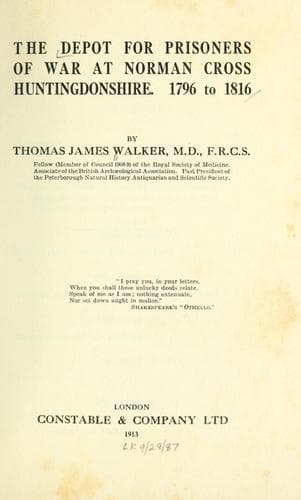
The Depot for Prisoners of War at Norman Cross, Huntingdonshire. 1796 to 1816Walker, Thomas (Thomas James)
History
The Depot for Prisoners of War at Norman Cross, Huntingdonshire. 1796 to 1816
Walker, Thomas (Thomas James)
France -- History -- 1789-1815; Norman Cross depot; Prisoners of war
Both the French and British Governments, to their credit, were ever ready
to deal generously and even magnanimously in the way of exchange or
release as a reward for some uncalled-for act of bravery or kindness on
the part of prisoners in connection with their captors. The following
are a few out of many such instances: In December 1811, twenty-one
English prisoners were released for assisting to extinguish a fire at
Auxonne; among these was the mate of an English merchant vessel, and for
him the mate of the French vessel _Achille_ was released from Lichfield,
he having assisted to put out a fire there. The colonel of the (French)
36th Regiment was allowed to go to France on parole to try to effect the
exchange of Colonel Cox, and failing this to return in three months. In
December 1810, Captain Bourde, of the French ship _Neptune_, was released
in consequence of his humanity to the officers and crew of the _Comet_, a
ship in the East India Company’s service. A French surgeon detained on
the prison ship _Assistance_, at Portsmouth, was exchanged “in
consequence of his attention to the British sick soldiers on board the
_Spence_ transport as represented by Lieut. J. W. Lloyd of the 8th King’s
Regiment.” A French captain of the land forces being taken prisoner, was
allowed to return to France “for his meritorious conduct in saving the
life of a British officer in the last war.” Five French officers were
released from Andover “for their exertions in extinguishing a fire at
that town.” A naval lieutenant was released by Admiralty order “for
saving a child’s life from a lion at Oswestry.” In April 1812, Pierre
Marie Tong was released from Portsmouth “in consideration of services
offered by his father to assist the _Conquisador_ when on shore on the
coast of France.” About the same date the second captain and clerk of a
privateer obtained their liberty “for saving the lives of seventy-nine
British seamen wrecked on the coast.”
Nor were these courtesies confined to officers. A seaman, prisoner at
Plymouth, was to be exchanged “for having leaped overboard and saved the
life of Alexander Muir on board the _Brave_, as per letter 3rd June
(1810) from Captain Hawkins.” A number of Lascars, prisoners at Dunkirk,
were exchanged for seamen at Norman Cross, the second captain for two,
and the captain at Chatham was considered worth three Lascars. We have,
in Appendix B, alluded to the release of Captain Woodriff. These bright
examples serve to illuminate what is otherwise a gloomy episode.
Public-domain text, read in full here on John Shaqi.
Reviews
Reviews
No reviews yet
Be the first to share your thoughts on this work.
Elsewhere in the archive
Join the Discussion
Join the discussion
Sign in to leave a comment or review.
Sign InorCreate an account