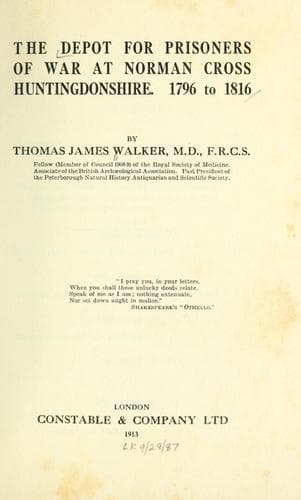
The Depot for Prisoners of War at Norman Cross, Huntingdonshire. 1796 to 1816Walker, Thomas (Thomas James)
History
The Depot for Prisoners of War at Norman Cross, Huntingdonshire. 1796 to 1816
Walker, Thomas (Thomas James)
France -- History -- 1789-1815; Norman Cross depot; Prisoners of war
His future wife, the daughter of a farmer in Stilton, was in the habit of
bringing up the milk bought for the prisoners’ use, and she would
probably have frequent interviews with the contractor’s assistant, and as
her granddaughter says, “she fell in love with him.” The attachment was
mutual, and when after his release he returned to France, he left his
heart behind him. During his imprisonment his father had died, leaving
property for his children, {210a} and Jean, when he had realised his
share, returned to England, married Miss Snow, and settled in business,
as a baker and corn merchant, in Stilton. The years of his imprisonment
had been sweetened by love, but his end was a tragic one. On 24th
January 1840, forty-three years after he passed through the prison gates
and first saw the hated caserns and fenced courts of Norman Cross, he was
killed within sight of the fields on which they stood.
He was returning from a round, which he had been making to collect money
from his customers, and it is supposed that at an inn in Peterborough he
had shown his well-filled purse, and was followed on the Norman Cross
Road to the spot about three miles from Peterborough, where he was found
with his head battered in and his pockets rifled, his empty purse being
found some time after in an adjacent field. {210b}
Such histories as have been here given from the writer’s long and
intimate knowledge of the locality might doubtless be collected in the
neighbourhood of other prisons, but the danger of assuming that the mere
occurrence of French names in the neighbourhood of a depot “still speak
of the old war time” has already been dealt with in Chap. IV, p. 59,
footnote.
The parole-breakers who managed to escape, varied from the humblest and
poorest of the non-combatants, who had to pass through many hardships and
trying adventures before securing their freedom, to men in the position
and affluence of General Lefebre, who, in May 1812, accompanied by his
wife, escaped from Cheltenham. He personated a German count; his wife,
in boy’s clothes, passed for his son, and his aide-de-camp acted as
valet. They put up at an hotel in Jermyn Street, got a passport, and
reached Dover in style, whence they were conveyed to the French coast.
From France he wrote an insolent letter to the English Government in
justification of his breach of parole.
A slightly different version was that he reached London as a Russian
General Officer, with two aides-de-camp, one of whom was his wife dressed
in military costume; all conversed in German.
Public-domain text, read in full here on John Shaqi.
Reviews
Reviews
No reviews yet
Be the first to share your thoughts on this work.
Elsewhere in the archive
Join the Discussion
Join the discussion
Sign in to leave a comment or review.
Sign InorCreate an account