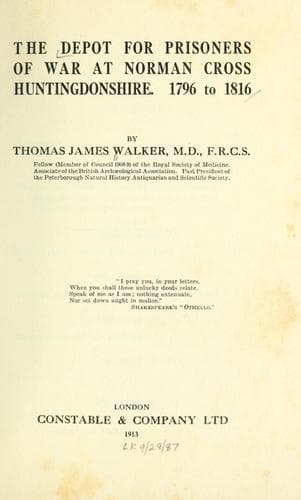
The Depot for Prisoners of War at Norman Cross, Huntingdonshire. 1796 to 1816Walker, Thomas (Thomas James)
History
The Depot for Prisoners of War at Norman Cross, Huntingdonshire. 1796 to 1816
Walker, Thomas (Thomas James)
France -- History -- 1789-1815; Norman Cross depot; Prisoners of war
(Signed) RUP. GEORGE, J. BOWEN, J. DOUGLAS. {213a}
* * * * *
There are no records to show that the conduct of those on parole from
Norman Cross, whether they were lodged in the prison or in the
neighbouring towns and villages, was otherwise than that of gentlemen,
and the records of broken parole are very scanty.
The prisoners reported themselves regularly twice a week, as the custom
was, to the agent at Peterborough, when he paid each his allowance; they
kept within bounds, and returned to their lodgings within the prescribed
hours.
No such amusing incident is told of any of them, as that told of the
French officer at Jedburgh, who, being an antiquarian, soon exhausted all
places of interest within the circle of one mile radius, beyond which the
country was out of bounds. Being told of a most interesting building a
little beyond the first milestone from the town, he nobly struggled
against the longing to go beyond that stone, and he was rewarded for his
strict adherence to his “Parole d’honneur,” for an inspiration came to
him, and, borrowing a spade and a wheel-barrow, he laboriously dug up the
milestone, and, putting it into his wheel-barrow, carted it beyond the
spot of his heart’s desire, and, replanting it there, revelled in his
research with unspotted honour. {213b}
Mr. Palmer, who was born in 1812, three years before Waterloo, and lived
on the North Road in a pretty farmhouse at Stibbington, opposite the
first milestone from Wansford, told the writer that when his grandfather
took the farm in 1797, the house was the Wheat Sheaf, a coaching inn,
which came to grief in 1841, killed by the railways, the house being
rechristened The Road Side Farm. The milestone was the outside limit for
those on parole who were quartered at Wansford (it was more than five
miles from Norman Cross), and Mr. Palmer pointed out the small room which
the prisoners used for smoking and recreation. His grandmother was
renowned for cooking, and could even please the fastidious taste of the
French officers. Mr. Palmer’s little baby eyes must often have looked
with wonder at the prisoners, talking in a language he could not
comprehend, and he must have gazed after them with childish curiosity, as
they turned—after a longing look into the forbidden land beyond—to
retrace their steps and reach their lodging within the time prescribed.
Public-domain text, read in full here on John Shaqi.
Reviews
Reviews
No reviews yet
Be the first to share your thoughts on this work.
Elsewhere in the archive
Join the Discussion
Join the discussion
Sign in to leave a comment or review.
Sign InorCreate an account