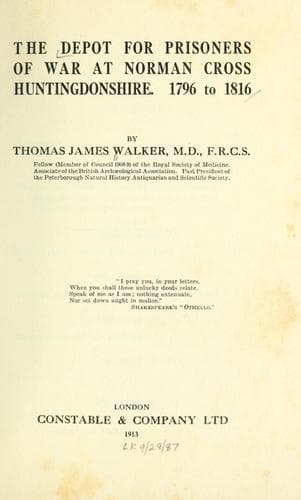
The Depot for Prisoners of War at Norman Cross, Huntingdonshire. 1796 to 1816Walker, Thomas (Thomas James)
History
The Depot for Prisoners of War at Norman Cross, Huntingdonshire. 1796 to 1816
Walker, Thomas (Thomas James)
France -- History -- 1789-1815; Norman Cross depot; Prisoners of war
In 1883 there were published, in _Notes and Queries_, {215a} some
interesting paragraphs dealing with the subject of the prisoners of war,
and these were embodied in the second edition of Sleigh’s _Leek_,
published in 1883. {215b} From these paragraphs the following condensed
notes are culled. The officers received all courtesy and hospitality
from the principal inhabitants of the town and neighbourhood. Those with
good private means used to dine out in full uniform, each with his body
servant stationed behind his chair. It is also stated that these
prisoners used to go out early and collect snails as a bonne-bouche for
breakfast. There were some men of mark among them. Of these, three died
during their captivity, and were buried with many other parole prisoners
in the God’s acre attached to the old church. There are memorial stones
to Joseph Dobee, Captain of _La Sophie_, ob. 2nd December 1811, æt. 54;
to Chevalier J. Baptiste Mullot, Captain of the 72nd French Regiment, ob.
9th June 1811, æt. 43; and to Charles Luneand, Captain in the French
Navy, ob. 4th March 1822. The latter officer must have settled in Leek,
the date of his death being seven years after Waterloo.
There are short notes on several others who were on parole at the Depot.
General Brunet, captured at St. Domingo in 1803, his aide-de-camp, his
adjutant, Col. Felix of the Artillery, and Lieut. Devoust of the Navy,
son of the Senator of that name, are mentioned. There is a note that M.
Bartin, a French naval officer, prisoner on parole about the space of
eleven years, behaved himself extremely well all the time he lived with
us. John Mien, servant to General Brunet, who was living in his
eighty-fifth year in 1870, as a boy of seven witnessed the execution of
Louis XVI., and heard the drums roll at Santerre’s command to drown the
monarch’s speech.
Several of the parole prisoners married. M. Salvert, commander in the
navy, married Helen Govstry of Leek Moor. Jean Toufflet, a sea-captain,
left issue in the town; his widow, _née_ Lorouds, died the 5th February
1870, æt. 84. M. Chouquet, a sea-captain, left a son living in 1870.
Joseph Vattel, cook to General Brunet, married Sarah Spilsbury. One,
Vandome, a naval officer and a most excellent linguist, used to render
the English papers into his native tongue for the benefit of his comrades
at the billiard-tables established by the officers.
That the prisoners on parole, like their fellow countrymen in close
confinement, added to their means of living by their industry, is proved
by the note in the history of Leek that there is in existence an old
card, intimating that “James Francis Neau, of Derby Street, sold straw
hats, beautiful straw, ivory and bone fancy articles, made by the French
prisoners,” and many exquisite models of ships and other nick-nacks,
still in existence, testify to the facile talent and marvellously patient
industry of these prisoners.
Public-domain text, read in full here on John Shaqi.
Reviews
Reviews
No reviews yet
Be the first to share your thoughts on this work.
Elsewhere in the archive
Join the Discussion
Join the discussion
Sign in to leave a comment or review.
Sign InorCreate an account