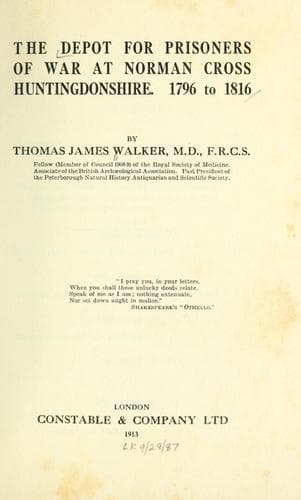
The Depot for Prisoners of War at Norman Cross, Huntingdonshire. 1796 to 1816Walker, Thomas (Thomas James)
History
The Depot for Prisoners of War at Norman Cross, Huntingdonshire. 1796 to 1816
Walker, Thomas (Thomas James)
France -- History -- 1789-1815; Norman Cross depot; Prisoners of war
This Francis Neau was a privateer officer who married a Mary Lees; she
was living in 1870.
There was a remarkable duel. A Captain Decourbes had been fishing, and,
coming in after curfew bell had tolled at 8 p.m., had to report himself
to Captain Grey, R.N., the Commissary. He afterwards met a Captain
Robert at the billiard-room at the Black’s Head, who grossly insulted him
and struck him in the face, so that the duel became inevitable. Neau,
who was present, was deputed to furnish them with firearms; but after
ransacking the town, he could only succeed in borrowing one horse-pistol
from a private in the Yeomanry. The two met on Balidone Moor at three
the next morning, and tossed for the first shot. Decourbes won, and hit
his adversary in the breast so that the ball entered at one side and came
out at the other. Robert, who was previously lame and had come on to the
ground on crutches, then, grievously wounded as he was, gathered himself
up and returned the fire, shooting Decourbes in the nape of the neck.
Lieut. Vird of the 72nd Regiment of Foot acted as Robert’s second; he was
subsequently killed at Waterloo.
They all walked back together to Leek, the two combatants treating their
wounds very lightly; but Decourbes’ wound went wrong, and he died of it
in the course of ten days or a fortnight.
The number of prisoners at Leek never exceeded 200, and they came by
detachments in 1803, 1805, 1809, and 1812, almost all clearing out after
Napoleon’s abdication 5th April 1814.
It will not be forgotten that in the earlier period of the war the
prisoners on parole in various parts of the country were all removed to
Norman Cross; whether any similar change in their condition was
experienced, after the resumption of hostilities in 1803, by the
prisoners out upon their parole, remains a matter of uncertainty.
Passing now to the subject of the Exchange of prisoners, and the chances
that a prisoner at Norman Cross or elsewhere had of obtaining his liberty
by an exchange for an English prisoner of equal rank, it must be borne in
mind that a large number of civilians were in captivity, especially in
the second period of the war.
This practice of taking captive so many civilians in the second period of
the war, 1803–15, was attributed to the British system of seizing all
French vessels of every kind and making their crews captive. This
practice was adopted as a retaliation for the first act of Buonaparte,
then ruling France as First Consul, when hostilities were resumed in May
1803. As a reprisal for what he considered the dishonourable action of
two British frigates in seizing in harbour French merchantmen before the
formal declaration of war had reached France, the Consul ordered the
immediate arrest of every British subject between the age of eighteen and
sixty who happened to be in France at that time, thus throwing 10,000
peaceable travellers and others into captivity.
Public-domain text, read in full here on John Shaqi.
Reviews
Reviews
No reviews yet
Be the first to share your thoughts on this work.
Elsewhere in the archive
Join the Discussion
Join the discussion
Sign in to leave a comment or review.
Sign InorCreate an account