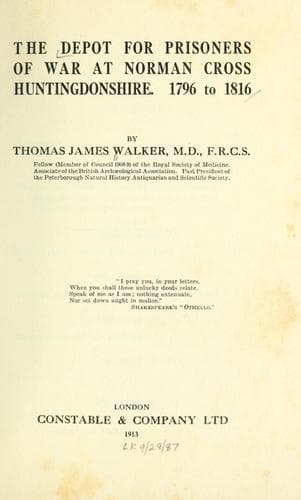
The Depot for Prisoners of War at Norman Cross, Huntingdonshire. 1796 to 1816Walker, Thomas (Thomas James)
History
The Depot for Prisoners of War at Norman Cross, Huntingdonshire. 1796 to 1816
Walker, Thomas (Thomas James)
France -- History -- 1789-1815; Norman Cross depot; Prisoners of war
During the second period of the war negotiations for exchange completely
failed. In April 1810, when there were about 10,000 British prisoners in
France, and 50,000 French in Britain, Mr. Mackenzie was sent by the
British Ministry to treat for a general exchange, the main condition in
the British proposal being that for every French prisoner returned to
France, a British prisoner of equal rank should be returned to Britain;
that this should go on until the whole of the British prisoners were
restored; and after that was accomplished, the British Government would
continue the restoration of the French, on the understanding that France
on her part returned to his native country, man for man, one of the
prisoners of Britain’s allies—_i.e._ a Spanish or Portuguese of equal
rank with the French prisoner handed over by Britain.
To this the French Emperor would not agree; he insisted that the British
and their allies should be reckoned as one army, and that for four
Frenchmen released from the British prisons and returned to France, only
one British subject should be returned to England, and three other
prisoners of various nationalities restored to their respective
Governments. On this plan, if the negotiations fell through while the
exchange was going on, say, when it was half way through, France would
have got back from Britain 20,000 of her veterans, England would have
received only 5,000 Britons, the balance, 15,000, being a rabble of
Spanish, Portuguese, and Italian levies of practically no value, and this
contention Buonaparte held to, although it was his opinion expressed a
few years later “that while as a fighting unit, you might set against
_one_ Frenchman _one_ Englishman, you would require _two_ Prussian,
Dutch, or soldiers of the Confederation.”
Buonaparte, referring to the failure of these negotiations, accounted for
his firmness by his want of faith in the British, and his conviction that
when they got their 10,000 countrymen back, they would find some excuse
to stop the further exchange. Could we, on our part, after the unfair
conduct of the exchanges, in the early part of the war, instances of
which with the Norman Cross prisoners have been given, rely on the French
Government carrying out in good faith even its own scheme, which on the
face of it showed a disregard of British rights. {222} The negotiations
fell through, and the great bulk of the prisoners at Norman Cross had to
drag out their weary life until the abdication of Buonaparte and his
retirement to Elba in 1814.
CHAPTER XI
BRITISH PRISONERS IN FRANCE—VERDUN—NARRATIVE OF THE REV. J. HOPKINSON
Oh, to be in England,
Now that April’s there,
And whoever wakes in England
Sees, some morning unaware,
That the lowest boughs and the brushwood sheaf,
Round the Elm tree bole are in tiny leaf,
While the Chaffinch sings in the orchard bough,
In England—now.
BROWNING.
Public-domain text, read in full here on John Shaqi.
Reviews
Reviews
No reviews yet
Be the first to share your thoughts on this work.
Elsewhere in the archive
Join the Discussion
Join the discussion
Sign in to leave a comment or review.
Sign InorCreate an account