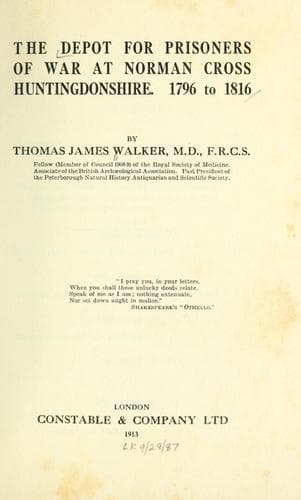
The Depot for Prisoners of War at Norman Cross, Huntingdonshire. 1796 to 1816Walker, Thomas (Thomas James)
History
The Depot for Prisoners of War at Norman Cross, Huntingdonshire. 1796 to 1816
Walker, Thomas (Thomas James)
France -- History -- 1789-1815; Norman Cross depot; Prisoners of war
In March 1797 M. Charretie, the French Commissary in England, enclosed a
list of thirty-six British seamen to be released without exchange for
their humanity in rescuing and aiding the crew of a French vessel bearing
the appropriate name of _Les Droits de l’Homme_.
Although it was a traffic strictly forbidden, some of the prisoners sold
their turn of exchange to their more wealthy comrades, the purchaser
assuming the name of the vendor, and vice versa. If detected, the vendor
forfeited his rights of exchange, and was kept a prisoner until the end
of the war. Notwithstanding this regulation, it was said that one man
had contrived to carry on these transactions from 1797 to 13th January
1800 without detection. This voluntary prolongation of the imprisonment
surely helps to prove the falsity of the statements of the French as to
the treatment of the prisoners by the British.
This practice of personating a fellow prisoner was carried out
occasionally under more tragic conditions.
In the course of the investigations to establish the facts of the
epidemic of 1800–01, a certificate was found with the name François le
Fevre crossed out, and the name of Bernard Batrille substituted, with a
note that the name of François le Fevre was assumed by Batrille when he
entered the hospital to die of consumption. This was, doubtless, not the
sole instance of such practices among the prisoners. A prisoner high up
in the list for exchange, who knew that he was dying, would, when about
to enter the hospital, for a sum of money or from friendship, exchange
his current number and his name with another man low down in the list,
the dying man, if this was done for payment, thus securing a sum of money
for his heirs in France, and the other increasing his chance of release
by exchange.
The case of Le Fevre and Batrille would have escaped detection, but for
the special investigation made by Captain Woodriff to establish the
identity of those who had died in the epidemic unrecognised. The
investigation led to the identification among the living prisoners of
François le Fevre, who had been personating Batrille, since he entered
the hospital, and had died, and was buried in the name of the former man.
During the first period of the war, 1793–1802, exchange went on, with
interruptions from the causes mentioned. The prisoners passed in a
sluggish stream through Norman Cross, but so sluggish that many of them
were there, confined or out on parole, during the whole five years.
Notwithstanding the exchange the prisons were at times greatly
overcrowded, and in 1801, when the French army in Egypt surrendered to
Abercrombie, such was the burden of prisoners that no attempt was made to
claim the troops as captives, but they were transported in British ships
to France.
Public-domain text, read in full here on John Shaqi.
Reviews
Reviews
No reviews yet
Be the first to share your thoughts on this work.
Elsewhere in the archive
Join the Discussion
Join the discussion
Sign in to leave a comment or review.
Sign InorCreate an account