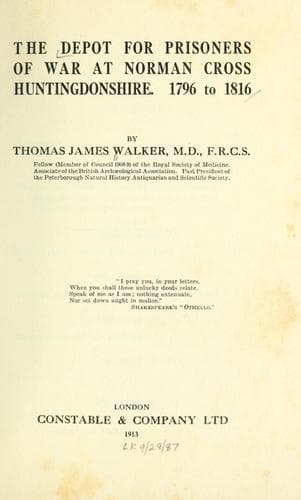
The Depot for Prisoners of War at Norman Cross, Huntingdonshire. 1796 to 1816Walker, Thomas (Thomas James)
History
The Depot for Prisoners of War at Norman Cross, Huntingdonshire. 1796 to 1816
Walker, Thomas (Thomas James)
France -- History -- 1789-1815; Norman Cross depot; Prisoners of war
“Lieutenants were allowed 56 francs a month from the French
Government, which just paid their lodging. No cause to complain of
indulgence, allowed to walk or ride 6 miles in every direction,
provided they were in before the shutting of the town gates at 9
o’clock at night. Captains were obliged to sign their names every 5
days, Lieutenants once a day, all other prisoners twice a day. No
other restrictions, could lodge where they pleased, and as they
liked. There was a first class of society, very good, but very
extravagant; they are chiefly people of fortune, who were detained
when travelling at the commencement of the war. The senior naval
English officer was Captain Gower, late of the _Shannon_, then
Captain Woodriff and 5 others, besides 38 Lieutenants.
“There were 2 clubs, where there were all the French, and sometimes
the English newspapers: in short, if a prisoner has health, he may
spend his time pleasantly enough.
“There is no society between the English and French; the latter are a
few Military, and tradesmen, who had made their fortunes by the
extravagance of Englishmen since the war.”
A fairly reliable picture of the life at Verdun may be gathered from a
comedy in two acts, called _The Prisoner of War_, by Douglas Jerrold,
produced at Drury Lane in 1812; the scene of the play is laid at Verdun.
Making allowance for dramatic licence, the situations are probably fairly
accurately described from the recollection of people known to the author.
There is the competition among landlords for prisoner lodgers, there is
the Jew money-lender who fattens on them, there are the breaches of
regulations, the escapes and punishments at the Fortress of Bitche, the
latter corresponding to the hulks at Chatham for delinquents in England.
From various detached sources we obtain other fragmentary glances of
Verdun, and learn that only British were confined there, the Austrians
and Prussians being at Chalons. As late as 1805 ordinary sailors were
also confined there, as it is recorded that a party managed to escape to
England in May of that year.
In the latter part of the same year a party of 150 were removed from
Verdun to Valenciennes. “The march took eight days. The _real
gentlemen_ were allowed on parole; the _négociants_, or merchants, were
confined.” The best account is from the portfolio of a _détenu_,
published in 1810. One quotation must suffice:
Public-domain text, read in full here on John Shaqi.
Reviews
Reviews
No reviews yet
Be the first to share your thoughts on this work.
Elsewhere in the archive
Join the Discussion
Join the discussion
Sign in to leave a comment or review.
Sign InorCreate an account