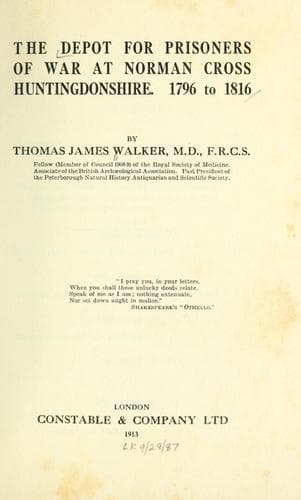
The Depot for Prisoners of War at Norman Cross, Huntingdonshire. 1796 to 1816Walker, Thomas (Thomas James)
History
The Depot for Prisoners of War at Norman Cross, Huntingdonshire. 1796 to 1816
Walker, Thomas (Thomas James)
France -- History -- 1789-1815; Norman Cross depot; Prisoners of war
“The number of prisoners of war at Verdun has generally amounted to
400, consisting chiefly of naval officers and masters of
merchant-ships, and including a few officers of the Army, who had
been shipwrecked on the French coast, and some passengers who had
been taken on their voyage from the East Indies. Add to these some
common seamen, who, instead of being sent to Givet or Saarlouis, the
usual depots for sailors, were permitted to remain at Verdun at the
intercession of any persons of respectability who would take them
into their service.”
There is another brief account by James Forbes, a member of the Society
of Antiquaries, who was detained for some months. Beyond the fact that
he was a prisoner in the town, and had to answer the daily roll-call, his
lot was not a hard one. By the interest of Sir Joseph Banks, the “Savant
Anglais” was released.
His book is valuable as giving the text of the release forms, etc. As
throwing light on the lot of the rank and file of the army and the
ordinary seamen, information has been culled from the article, “Prisoners
of War,” published in _Chambers’ Journal_, 1854. This article deals
shortly with the treatment and conduct of the British prisoners in
France. The writer says that on the long march into the interior they
were often treated cruelly and harshly, occasionally handcuffed; they
were escorted by soldiers of the line, the character of their treatment
depending, naturally, greatly upon the officer in command. This writer
confirms the dietary mentioned already. The prisoners were paid by the
French Government a sou and a half (not quite three farthings) a day;
this was supplemented by a penny a day from a fund raised by public
subscription in England, the masters and mates of merchantmen
participating in this small but welcome addition to their subsistence.
In accordance with the directions of Othello quoted on our title page, we
must quote from the article the remarks on the conduct of our countrymen
in captivity.
“Brandy and spirits being cheap, the Britishers often got intoxicated
and gave endless troubles to the incensed officials. Their conduct
was that of the proverbial, reckless British seaman. They did no
work, but spent their time in playing rough games of every
description, singing, speechifying, fighting, drinking, and taunting
and defying the French, Frog-eating Mounseers, all and sundry, who,
by the way, often made them rue their rough pranks. Insubordination
was commonly punished by separate confinement with bread and water,
and worst of all, and unendurable to English Jack, a total
deprivation of tobacco. . . . Any personal assault on the soldiers
or the gendarmes was a most serious offence, the punishment of death
being assigned to the striking a gendarme. In some instances this
terrible and outrageous penalty was actually carried into effect.”
Public-domain text, read in full here on John Shaqi.
Reviews
Reviews
No reviews yet
Be the first to share your thoughts on this work.
Elsewhere in the archive
Join the Discussion
Join the discussion
Sign in to leave a comment or review.
Sign InorCreate an account