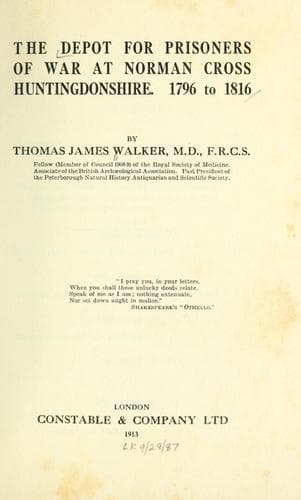
The Depot for Prisoners of War at Norman Cross, Huntingdonshire. 1796 to 1816Walker, Thomas (Thomas James)
History
The Depot for Prisoners of War at Norman Cross, Huntingdonshire. 1796 to 1816
Walker, Thomas (Thomas James)
France -- History -- 1789-1815; Norman Cross depot; Prisoners of war
It will be in the recollection of the reader that the British Government
provided the clothing of their subjects who were captives in a foreign
prison of war. The dress is described by the author of the article in
_Chambers’ Journal_ as a gray jacket and trousers and a straw hat; it
contrasted favourably with the suit of many colours in which our
Government clad their French prisoners.
In the paragraphs in which the article deals with the British prisoners
in Denmark, the anonymous writer shows a sympathy with Denmark which may
account for the severe language in which he deals with the British
prisoners in that country. In describing their gambling propensities and
consequent moral depravity he uses almost the actual words used by
Captain Woodriff and others when they described Les Misérables and their
class in the English prisons.
Possibly some future searcher in the bypaths of history may take up the
subject of British prisoners of war in the countries of their captors,
and we may hope that the result of his researches will form a picture of
our countrymen more agreeable to the British eye than that depicted by
the writer in _Chambers’ Journal_. {238}
CHAPTER XII
THE TRUCE AND THE PEACE—PRISON EVACUATED, 1802—FINALLY CLEARED,
1814—DEMOLISHED, 1816
Joyous presage of ultimate bliss
For the heart long depressed by vain yearning;
Timely token of pardon—the kiss
That reviveth Faith’s innermost burning;
Peace prevailing o’er War’s artifice,
Love o’er Hate, and delight over Mourning.
NORMAN HILL, _Lingering Winter_.
WITH what feverish anxiety must the occupants of the courts and caserns
of Norman Cross have listened to the garbled accounts of the progress of
the war which reached their ears towards the close of the eighteenth and
the dawn of the nineteenth centuries. How their hopes must have been
raised when they heard of the defeat of the Austrians by Moreau at
Hohenlinden, of the sudden crossing of the Alps by their hero Buonaparte,
his swoop on to another Austrian army and its defeat at Marengo. When
they learned that in 1800 Austria had signed a Treaty of Peace with
France (The Treaty of Lunéville, Feb. 1801) and that England was left to
fight single-handed, they must have thought delivery extremely near. To
cheer them further would come the news of the alliance of Russia,
Denmark, Sweden, and Prussia to constitute “the armed neutrality,” which
though not actually at war with Great Britain, was formed to check her
progress and paralyse her navy. The time when the French Army would have
England under its foot and the prison doors would be thrown open must be
close at hand.
Public-domain text, read in full here on John Shaqi.
Reviews
Reviews
No reviews yet
Be the first to share your thoughts on this work.
Elsewhere in the archive
Join the Discussion
Join the discussion
Sign in to leave a comment or review.
Sign InorCreate an account