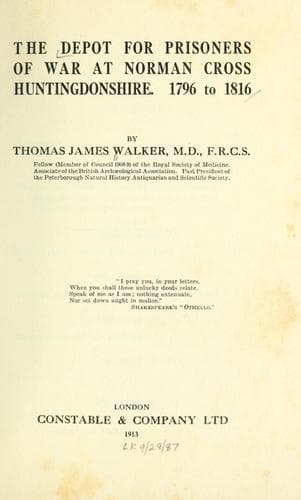
The Depot for Prisoners of War at Norman Cross, Huntingdonshire. 1796 to 1816Walker, Thomas (Thomas James)
History
The Depot for Prisoners of War at Norman Cross, Huntingdonshire. 1796 to 1816
Walker, Thomas (Thomas James)
France -- History -- 1789-1815; Norman Cross depot; Prisoners of war
Some months later Buonaparte in a State paper practically challenged
Great Britain to fight him single-handed, as she would be if war broke
out again. After much fruitless negotiation England declared war against
France on the 16th May 1803, and eleven years more were added to the
active existence of Norman Cross, as one factor in the gigantic struggle
between the two nations. Six days after the declaration of war, France,
by the First Consul’s decree, filled her prisons with the 10,000 British
men of all degrees, between the age of eighteen and sixty, whom she found
within her bounds at that date. This step she justified as a fair
reprisal for the action of an English captain who seized two French
merchant vessels before the declaration of war had reached the French
Minister. Buonaparte knew that a bill for a _levée en masse_ had been
presented to Parliament, and that to secure, before they could be
enrolled, 10,000 of the able-bodied men of the nation, (the whole of the
population at that date was only twelve and a half million) was a wise
step.
Our Admiralty, immediately after the renewal of the war, called upon the
Transport Board to find depots for the parole prisoners, whom we were
taking, in merchant vessels and other craft, not ships of war. Bishops
Waltham and Tavistock were suggested, and should the numbers be
considerable, Oldham and Tiverton were to be added, while Stapleton
Prison was to be prepared for prisoners of war. This, it will be
remembered, was the third and last time that Stapleton had been
requisitioned for such a purpose, it having been built originally in 1782
to receive prisoners taken in the war which was ended in the following
year by the Treaty of Versailles. In 1833 it was converted into a
workhouse.
The prisons first suggested, being deemed insufficient, Peterborough was
proposed to the Transport Board, and the Board replied, that on receipt
of an intimation from the Admiralty, they would make the necessary
arrangements for the reception of prisoners at Norman Cross.
On 18th June 1803 the Admiralty appointed, as agents for prisoners of
war, Captain Thesiger at Portsmouth, Captain Baker at Stapleton, Captain
Pressland at Liverpool, Captain Poulden at Norman Cross.
In consequence of Stapleton being used instead of Liverpool, Captain
Pressland, R.N., was sent to Norman Cross, at a salary, in addition to
his full pay, of £200 per annum, and 7_s._ 6_d._ _per diem_ for expenses.
{247} Thus manned for the work, the Norman Cross Depot started on the
eleven years of arduous work which lay before it. The agents were to be
in supreme authority, but were not to interfere with the medical or
surgical treatment of the sick, this being entirely in the hands of the
Board of the Sick and Hurt.
Mr. Hadley of Lynn contracted to convey prisoners to and from Norman
Cross on lighters at 1_s._ 9_d._ each, and to victual them at 7_d._ each,
the military guard being carried on the same terms.
Public-domain text, read in full here on John Shaqi.
Reviews
Reviews
No reviews yet
Be the first to share your thoughts on this work.
Elsewhere in the archive
Join the Discussion
Join the discussion
Sign in to leave a comment or review.
Sign InorCreate an account