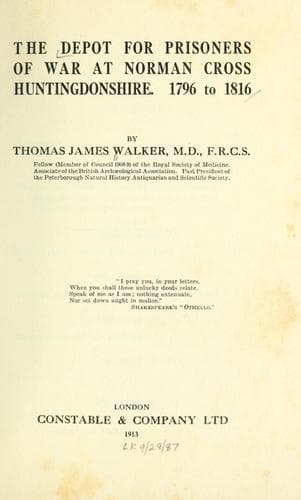
The Depot for Prisoners of War at Norman Cross, Huntingdonshire. 1796 to 1816Walker, Thomas (Thomas James)
History
The Depot for Prisoners of War at Norman Cross, Huntingdonshire. 1796 to 1816
Walker, Thomas (Thomas James)
France -- History -- 1789-1815; Norman Cross depot; Prisoners of war
But its conditions were not such as to satisfy the British, who gave up
all their conquests but Trinidad and Ceylon, restored the Cape to
Holland, with the condition that it should be a free port, and agreed
that Malta was to go back to the Knights of St. John, under the guarantee
of one of the Great Powers. France also made sacrifices and withdrew
claims, but to the British nation these did not appear to balance those
made by their own Government. Buonaparte had no intention of allowing
the peace to be more than a truce. Among other objects he had in view,
he recovered his veterans from their confinement in English prisons, and
he never paused in his ambitious schemes. He strove to increase French
influence in Switzerland, Holland, and Italy. Under the name of consuls
he sent agents to England and Ireland, their real object being to make
themselves acquainted with the resources of those countries and the
chance of their successful invasion. Egypt had been restored to the
Porte by the Treaty, but instead of evacuating that country, the First
Consul was utilising his position there to equip a fresh army.
In the face of these proceedings Britain did not withdraw her troops from
Egypt, nor did she evacuate Malta, which she should have done in
fulfilment of the Article which restored that island to the Knights of
St. John. Angry disputes arose over her action, or rather want of
action, in this matter. Commenting on the Treaty of Amiens, Count
Guillaume de Garden {245} writes:
“L’article est le plus important de tout le Traité, mais aucune des
conditions qu’il renferme n’a été exécutée et il est devenu le
prétexte d’une guerre, qui s’est renouvelée en 1803 et a duré sans
interruption jusqu’en 1814.”
The complaint of the First Consul against the English Press, and his
demands that Britain should alter her laws, putting restraints on the
liberty of the Press, and depriving of their freedom those living under
her protection, roused the indignation of the country. The British
Government prosecuted under her own laws a Frenchman, M. Peltier, who in
articles he had written had brought himself within the arm of the law of
the land, but it refused to alter those laws at the bidding of another
power. M. Norvus, Napoleon’s apologist, wrote:
“Napoleon demanded from Great Britain what was nearly the same thing
as proposing the sacrifice of its constitution, and to insist upon
its abandoning the two pillars of its freedom, the liberty of the
press, and the privilege of Habeas Corpus.”
Public-domain text, read in full here on John Shaqi.
Reviews
Reviews
No reviews yet
Be the first to share your thoughts on this work.
Elsewhere in the archive