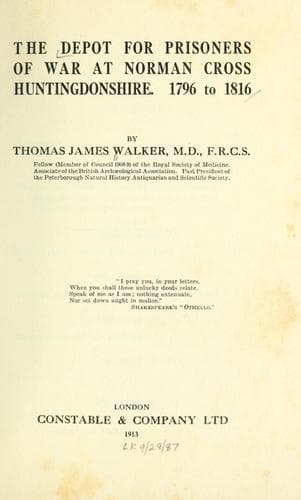
The Depot for Prisoners of War at Norman Cross, Huntingdonshire. 1796 to 1816Walker, Thomas (Thomas James)
History
The Depot for Prisoners of War at Norman Cross, Huntingdonshire. 1796 to 1816
Walker, Thomas (Thomas James)
France -- History -- 1789-1815; Norman Cross depot; Prisoners of war
“On 20th June, when the last draft was being formed, it happened that
one unfortunate man could not produce his bedding; probably it had
been stolen by others to make up their complement. On being refused
at the gate, he rushed frantically back into his prison to look for
it, and then, fearful of being left behind, he ran back to the gate
to plead his cause with the guard. On being again refused he became
frantic with grief, and crying that he had been eleven years in
prison, in an agony of despair he pulled out his knife, and there
before the guards and his own countrymen cut his throat. There is no
more sorrowful incident in the history of Dartmoor.” {253b}
When the gate closed behind that man who had been left in Norman Cross on
the 19th August, it closed for the last time on a prisoner. The campaign
of a hundred days which followed between the escape of Napoleon from Elba
and his final defeat at Waterloo sent no prisoners to the Depot, and in
1816 the buildings were demolished and the site sold. The sale,
including that of the remaining stores, furniture, and fixtures, occupied
thirteen days and realised only £11,060 4_s._ 4_d._ {254}
[Picture: One of the Wells on the Site of the Prison. From a photograph
by the Rev. E. H. Brown, July 1910]
In Peterborough, Stilton, and the neighbouring villages much of the
material sold was re-erected and is still in use; but on the site itself,
the houses of the barrack master, the agent, and the steward, the wells,
the wide fosse which ran round inside the outer wall, and about 60 yards
of the wall itself, alone remain of that Norman Cross Prison which, for
twenty years in the most eventful period in the history of Europe, played
so important a part; over which, and its inmates, the two Governments,
French and English, argued and fought, while the prisoners suffered.
That prison, where these victims of war—our foemen, it is true, but
patriots, and foemen worthy of our steel—pined in prolonged confinement,
surrounded by prison walls, held down by cannon, muskets, and bayonets,
hoping for release which never came, enduring an agonising longing for
freedom—a longing so keen that many of them purchased it by enlisting in
the ranks of Britain, their country’s enemy—and suffering, alas! other
miseries, of which not the least was the moral deterioration and
degradation consequent on their condition and surroundings. Gone are the
prisons and their miseries, gone the barracks and their busy life of
active duties, and gone, also, all personal recollection of the great
events of 1789 to 1816, of which the life here was a part.
Public-domain text, read in full here on John Shaqi.
Reviews
Reviews
No reviews yet
Be the first to share your thoughts on this work.
Elsewhere in the archive
Join the Discussion
Join the discussion
Sign in to leave a comment or review.
Sign InorCreate an account