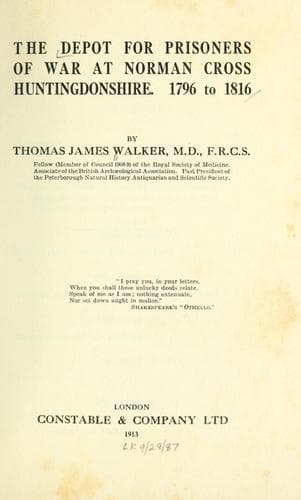
The Depot for Prisoners of War at Norman Cross, Huntingdonshire. 1796 to 1816Walker, Thomas (Thomas James)
History
The Depot for Prisoners of War at Norman Cross, Huntingdonshire. 1796 to 1816
Walker, Thomas (Thomas James)
France -- History -- 1789-1815; Norman Cross depot; Prisoners of war
{31} The most valuable direct evidence as to the appearance of the
barracks and prison which I was able to obtain in 1891, was from an old
Mr. Lewin of Yaxley, who was born in 1802, and had been very familiar
with the Depot in his childhood. He used frequently to ride in through
this west gate in the tradesmen’s carts, but he spoke always of the
entrance on the south front as the main entrance. This old gentleman’s
memory was wonderfully clear, and his accounts I regarded as thoroughly
trustworthy.
{34} The well-known Stilton cheese was never made at Stilton, which was
not in a dairy district; it was made in Leicestershire and sent to
Stilton, where Mr. Cooper Thornhill, the sporting landlord of the old
sixteenth-century coaching inn, The Bell (he once for a wager rode 218
miles on horseback in 12 hours and 15 minutes), used to supply it to his
customers, selling the cheeses, it is said, at half a crown a pound.
{38a} To the post of agent at Norman Cross there were appointed, during
the seventeen years in which the prison was occupied, two civilians and
four naval officers. Of the two civilians, Mr. John Delafons sent in his
formal resignation eight days after his appointment.
Mr. James Perrot, appointed on the 7th April 1797, held his office until
January 1799.
Captain Woodriff, R.N., appointed January 1799, held his office until the
Peace of Amiens, April 1802 (see Appendix B).
Captain Thos. Pressland, R.N., was appointed after the War was renewed in
May 1803, and served from 18th June 1803 until August 1811.
Captain J. Draper, R.N., succeeded to the post, and held it until his
death in February 1813.
Captain W. Hansell, R.N., became agent on the death of Captain Draper,
and relinquished the post in August 1814 after the Abdication of
Buonaparte and his retirement to Elba.
{38b} There is evidence in correspondence still extant, that much
friction arose between the commander of the Military Guard and the agent,
as to the power of the latter to interfere in the steps required for the
safe custody of the prisoners.
{40} This shows that about 4,000 prisoners were to be removed from
Falmouth to Norman Cross, their hammocks, added to the 1,000 on the way
from London, making the number correspond with the 5,000 sets of bedding.
{42} _Lavengro_, chap. iii.
{44} Evidence that two years later meat could be obtained at a much
lower rate has come under my notice, from an unexpected source. On the
fly-leaf of a copy of Batty’s Bible, in the possession of a descendant of
Mr. W. Fowler, is written below the name W. Fowler (in the same writing,
but in paler ink), “Came down to Norman Cross March 10th, 1799, to serve
the prisoners of War at Yaxley.” In a different handwriting has been
inserted after “Came down,” “from London,” and after Yaxley, “with Beef
at 28_s._ the cwt.” The date 1799 has also been altered in dark ink to
1795, which was of course a wrong correction, as there was no prison at
Norman Cross until 1797.—T. J. W.
Public-domain text, read in full here on John Shaqi.
Reviews
Reviews
No reviews yet
Be the first to share your thoughts on this work.
Elsewhere in the archive
Join the Discussion
Join the discussion
Sign in to leave a comment or review.
Sign InorCreate an account