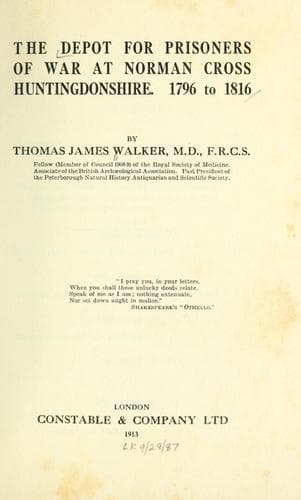
The Depot for Prisoners of War at Norman Cross, Huntingdonshire. 1796 to 1816Walker, Thomas (Thomas James)
History
The Depot for Prisoners of War at Norman Cross, Huntingdonshire. 1796 to 1816
Walker, Thomas (Thomas James)
France -- History -- 1789-1815; Norman Cross depot; Prisoners of war
{46} Appendix B, Biographical Sketch of Captain Woodriff.
{49} So slowly did the Government inquiry which followed on Captain
Woodriff’s report progress, that it was not until two years later that
judgment was pronounced.—_Naval Chronicle_, vol. i., pp. 523–6.
{50} For examples of the individual entries in the General Register, the
Death Register, and the Register of Prisoners on Parole, see Appendix C.
{52} Cartel is an agreement between foreign states as to the exchange of
the prisoners; its meaning was extended to the document authorising the
exchange of an individual prisoner, and it was even used to signify the
transport vessel engaged to convey the exchanged prisoners to their
native country.
{59} In All Souls’ Church at Peterborough is preserved the Register,
kept by the resident Priest at King’s Cliff, of the baptisms performed by
priests within the mission of his church. Stilton, the Depot, and the
surrounding villages were within that district. Two of the entries are
baptisms of the sons of Delapoux; they will be referred to in a future
chapter. They have always been supposed to be those of the baptism of
the children of a French prisoner, who had married an English wife (these
marriages were of rare occurrence), and the discovery in the Record
Office of this entry of John Andrew Delapoux’s appointment as a clerk is
an instance of the way in which research upsets old traditions. I find
the entry of Delapoux’s marriage to Sarah Mason on the 2nd September
1802, in the Register of Stilton church. His children were baptized as
Catholics, and the priest specially calls Sarah Mason his lawful wife.
Another instance in this list, selected haphazard by Mr. Rhodes from
papers in the Record Office, shows how in two generations a false family
tradition may arise. In 1894 I visited, in search of information, the
daughter-in-law, then a widow aged eighty-six, of the James Robinette
whose engagement as a permanent mason and labourer at the Depot is
recorded on page 61. She told me her husband’s father was a French
prisoner, who had been made a turnkey at the Barracks! On searching the
church Register, 1 found that the Robinettes had been residents in Yaxley
fifty years at least before the arrival of the prisoners at Norman Cross,
and between 1748 and 1796 the records of three generations appear in the
register—James, the son of James and Catherine Robinette, born in 1780,
was doubtless the man appointed in 1813 to the job at the Barracks.
Public-domain text, read in full here on John Shaqi.
Reviews
Reviews
No reviews yet
Be the first to share your thoughts on this work.
Elsewhere in the archive
Join the Discussion
Join the discussion
Sign in to leave a comment or review.
Sign InorCreate an account