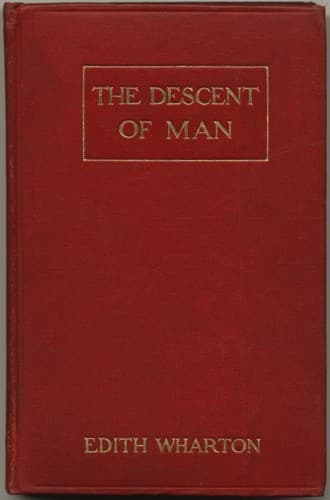
The Descent of Man and Other StoriesWharton, Edith
General
The Descent of Man and Other Stories
Wharton, Edith
New York (N.Y.) -- Social life and customs -- Fiction; Short stories
Her son, who had overtaken her on the door-step, followed her into the
drawing-room, and threw himself into an armchair near the fire, while
she laid off her furs and busied herself about the tea table. For a
while neither spoke; but glancing at him across the kettle, his mother
noticed that he sat staring at the embers with a look she had never
seen on his face, though its arrogant young outline was as familiar to
her as her own thoughts. The look extended itself to his negligent
attitude, to the droop of his long fine hands, the dejected tilt of his
head against the cushions. It was like the moral equivalent of physical
fatigue: he looked, as he himself would have phrased it, dead-beat,
played out. Such an air was so foreign to his usual bright
indomitableness that Mrs. Quentin had the sense of an unfamiliar
presence, in which she must observe herself, must raise hurried
barriers against an alien approach. It was one of the drawbacks of
their excessive intimacy that any break in it seemed a chasm.
She was accustomed to let his thoughts circle about her before they
settled into speech, and she now sat in motionless expectancy, as
though a sound might frighten them away.
At length, without turning his eyes from the fire, he said: "I'm so
glad you're a nice old-fashioned intuitive woman. It's painful to see
them think."
Her apprehension had already preceded him. "Hope Fenno--?" she faltered.
He nodded. "She's been thinking--hard. It was very painful--to me, at
least; and I don't believe she enjoyed it: she said she didn't." He
stretched his feet to the fire. "The result of her cogitations is that
she won't have me. She arrived at this by pure ratiocination--it's not
a question of feeling, you understand. I'm the only man she's ever
loved--but she won't have me. What novels did you read when you were
young, dear? I'm convinced it all turns on that. If she'd been brought
up on Trollope and Whyte-Melville, instead of Tolstoi and Mrs. Ward, we
should have now been vulgarly sitting on a sofa, trying on the
engagement-ring."
Mrs. Quentin at first was kept silent by the mother's instinctive anger
that the girl she has not wanted for her son should have dared to
refuse him. Then she said, "Tell me, dear."
"My good woman, she has scruples."
"Scruples?"
"Against the paper. She objects to me in my official capacity as owner
of the _Radiator_."
His mother did not echo his laugh.
"She had found a solution, of course--she overflows with expedients. I
was to chuck the paper, and we were to live happily ever afterward on
canned food and virtue. She even had an alternative ready--women are so
full of resources! I was to turn the _Radiator_ into an independent
organ, and run it at a loss to show the public what a model newspaper
ought to be. On the whole, I think she fancied this plan more than the
other--it commended itself to her as being more uncomfortable and
aggressive. It's not the fashion nowadays to be good by stealth."
Public-domain text, read in full here on John Shaqi.
Reviews
Reviews
No reviews yet
Be the first to share your thoughts on this work.
Elsewhere in the archive
Join the Discussion
Join the discussion
Sign in to leave a comment or review.
Sign InorCreate an account