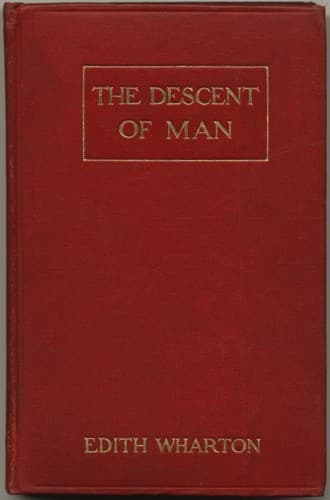
The Descent of Man and Other StoriesWharton, Edith
General
The Descent of Man and Other Stories
Wharton, Edith
New York (N.Y.) -- Social life and customs -- Fiction; Short stories
Mrs. Quentin said to herself, "I didn't know how much he cared!" Aloud
she murmured, "You must give her time."
"Time?"
"To move out the old prejudices and make room for new ones."
"My dear mother, those she has are brand-new; that's the trouble with
them. She's tremendously up-to-date. She takes in all the moral
fashion-papers, and wears the newest thing in ethics."
Her resentment lost its way in the intricacies of his metaphor. "Is she
so very religious?"
"You dear archaic woman! She's hopelessly irreligious; that's the
difficulty. You can make a religious woman believe almost anything:
there's the habit of credulity to work on. But when a girl's faith in
the Deluge has been shaken, it's very hard to inspire her with
confidence. She makes you feel that, before believing in you, it's her
duty as a conscientious agnostic to find out whether you're not
obsolete, or whether the text isn't corrupt, or somebody hasn't proved
conclusively that you never existed, anyhow."
Mrs. Quentin was again silent. The two moved in that atmosphere of
implications and assumptions where the lightest word may shake down the
dust of countless stored impressions; and speech was sometimes more
difficult between them than had their union been less close.
Presently she ventured, "It's impossible?"
"Impossible?"
She seemed to use her words cautiously, like weapons that might slip
and inflict a cut. "What she suggests."
Her son, raising himself, turned to look at her for the first time.
Their glance met in a shock of comprehension. He was with her against
the girl, then! Her satisfaction overflowed in a murmur of tenderness.
"Of course not, dear. One can't change--change one's life...."
"One's self," he emended. "That's what I tell her. What's the use of my
giving up the paper if I keep my point of view?"
The psychological distinction attracted her. "Which is it she minds
most?"
"Oh, the paper--for the present. She undertakes to modify the point of
view afterward. All she asks is that I shall renounce my heresy: the
gift of grace will come later."
Mrs. Quentin sat gazing into her untouched cup. Her son's first words
had produced in her the hallucinated sense of struggling in the thick
of a crowd that he could not see. It was horrible to feel herself
hemmed in by influences imperceptible to him; yet if anything could
have increased her misery it would have been the discovery that her
ghosts had become visible.
As though to divert his attention, she precipitately asked, "And you--?"
His answer carried the shock of an evocation. "I merely asked her what
she thought of _you_."
"Of me?"
"She admires you immensely, you know."
For a moment Mrs. Quentin's cheek showed the lingering light of
girlhood: praise transmitted by her son acquired something of the
transmitter's merit. "Well--?" she smiled.
"Well--you didn't make my father give up the _Radiator_, did you?"
His mother, stiffening, made a circuitous return: "She never comes
here. How can she know me?"
Public-domain text, read in full here on John Shaqi.
Reviews
Reviews
No reviews yet
Be the first to share your thoughts on this work.
Elsewhere in the archive
Join the Discussion
Join the discussion
Sign in to leave a comment or review.
Sign InorCreate an account