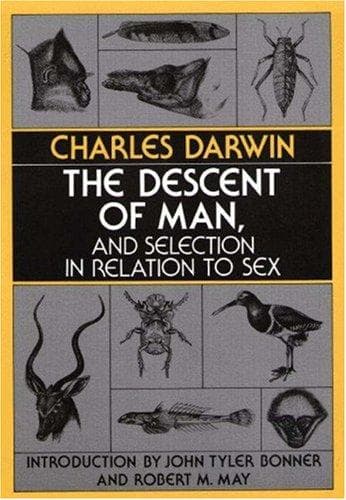
The Descent of Man, and Selection in Relation to SexDarwin, Charles
History
The Descent of Man, and Selection in Relation to Sex
Darwin, Charles
Evolution (Biology); Human beings -- Origin; Sex differences; Sexual dimorphism (Animals); Sexual selection in animals
As Horne Tooke, one of the founders of the noble science of philology,
observes, language is an art, like brewing or baking; but writing would
have been a better simile. It certainly is not a true instinct, for
every language has to be learnt. It differs, however, widely from all
ordinary arts, for man has an instinctive tendency to speak, as we see
in the babble of our young children; whilst no child has an instinctive
tendency to brew, bake, or write. Moreover, no philologist now supposes
that any language has been deliberately invented; it has been slowly
and unconsciously developed by many steps. (53. See some good remarks
on this head by Prof. Whitney, in his ‘Oriental and Linguistic
Studies,’ 1873, p. 354. He observes that the desire of communication
between man is the living force, which, in the development of language,
“works both consciously and unconsciously; consciously as regards the
immediate end to be attained; unconsciously as regards the further
consequences of the act.”) The sounds uttered by birds offer in several
respects the nearest analogy to language, for all the members of the
same species utter the same instinctive cries expressive of their
emotions; and all the kinds which sing, exert their power
instinctively; but the actual song, and even the call-notes, are learnt
from their parents or foster-parents. These sounds, as Daines
Barrington (54. Hon. Daines Barrington in ‘Philosoph. Transactions,’
1773, p. 262. See also Dureau de la Malle, in ‘Ann. des. Sc. Nat.’ 3rd
series, Zoolog., tom. x. p. 119.) has proved, “are no more innate than
language is in man.” The first attempts to sing “may be compared to the
imperfect endeavour in a child to babble.” The young males continue
practising, or as the bird-catchers say, “recording,” for ten or eleven
months. Their first essays shew hardly a rudiment of the future song;
but as they grow older we can perceive what they are aiming at; and at
last they are said “to sing their song round.” Nestlings which have
learnt the song of a distinct species, as with the canary-birds
educated in the Tyrol, teach and transmit their new song to their
offspring. The slight natural differences of song in the same species
inhabiting different districts may be appositely compared, as
Barrington remarks, “to provincial dialects”; and the songs of allied,
though distinct species may be compared with the languages of distinct
races of man. I have given the foregoing details to shew that an
instinctive tendency to acquire an art is not peculiar to man.
Public-domain text, read in full here on John Shaqi.
Reviews
Reviews
No reviews yet
Be the first to share your thoughts on this work.
Elsewhere in the archive
Join the Discussion
Join the discussion
Sign in to leave a comment or review.
Sign InorCreate an account