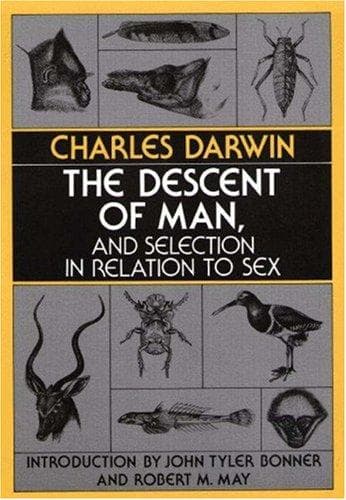
The Descent of Man, and Selection in Relation to SexDarwin, Charles
History
The Descent of Man, and Selection in Relation to Sex
Darwin, Charles
Evolution (Biology); Human beings -- Origin; Sex differences; Sexual dimorphism (Animals); Sexual selection in animals
With respect to the origin of articulate language, after having read on
the one side the highly interesting works of Mr. Hensleigh Wedgwood,
the Rev. F. Farrar, and Prof. Schleicher (55. ‘On the Origin of
Language,’ by H. Wedgwood, 1866. ‘Chapters on Language,’ by the Rev.
F.W. Farrar, 1865. These works are most interesting. See also ‘De la
Phys. et de Parole,’ par Albert Lemoine, 1865, p. 190. The work on this
subject, by the late Prof. Aug. Schleicher, has been translated by Dr.
Bikkers into English, under the title of ‘Darwinism tested by the
Science of Language,’ 1869.), and the celebrated lectures of Prof. Max
Muller on the other side, I cannot doubt that language owes its origin
to the imitation and modification of various natural sounds, the voices
of other animals, and man’s own instinctive cries, aided by signs and
gestures. When we treat of sexual selection we shall see that primeval
man, or rather some early progenitor of man, probably first used his
voice in producing true musical cadences, that is in singing, as do
some of the gibbon-apes at the present day; and we may conclude from a
widely-spread analogy, that this power would have been especially
exerted during the courtship of the sexes,—would have expressed various
emotions, such as love, jealousy, triumph,—and would have served as a
challenge to rivals. It is, therefore, probable that the imitation of
musical cries by articulate sounds may have given rise to words
expressive of various complex emotions. The strong tendency in our
nearest allies, the monkeys, in microcephalous idiots (56. Vogt,
‘Mémoire sur les Microcephales,’ 1867, p. 169. With respect to savages,
I have given some facts in my ‘Journal of Researches,’ etc., 1845, p.
206.), and in the barbarous races of mankind, to imitate whatever they
hear deserves notice, as bearing on the subject of imitation. Since
monkeys certainly understand much that is said to them by man, and when
wild, utter signal-cries of danger to their fellows (57. See clear
evidence on this head in the two works so often quoted, by Brehm and
Rengger.); and since fowls give distinct warnings for danger on the
ground, or in the sky from hawks (both, as well as a third cry,
intelligible to dogs) (58. Houzeau gives a very curious account of his
observations on this subject in his ‘Facultés Mentales des Animaux,’
tom. ii. p. 348.), may not some unusually wise ape-like animal have
imitated the growl of a beast of prey, and thus told his fellow-monkeys
the nature of the expected danger? This would have been a first step in
the formation of a language.
Public-domain text, read in full here on John Shaqi.
Reviews
Reviews
No reviews yet
Be the first to share your thoughts on this work.
Elsewhere in the archive
Join the Discussion
Join the discussion
Sign in to leave a comment or review.
Sign InorCreate an account