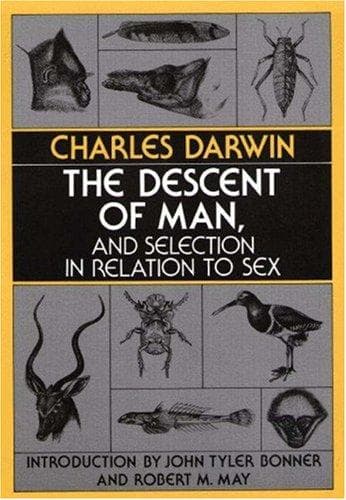
The Descent of Man, and Selection in Relation to SexDarwin, Charles
History
The Descent of Man, and Selection in Relation to Sex
Darwin, Charles
Evolution (Biology); Human beings -- Origin; Sex differences; Sexual dimorphism (Animals); Sexual selection in animals
Several writers, more especially Prof. Max Muller (62. Lectures on ‘Mr.
Darwin’s Philosophy of Language,’ 1873.), have lately insisted that the
use of language implies the power of forming general concepts; and that
as no animals are supposed to possess this power, an impassable barrier
is formed between them and man. (63. The judgment of a distinguished
philologist, such as Prof. Whitney, will have far more weight on this
point than anything that I can say. He remarks (‘Oriental and
Linguistic Studies,’ 1873, p. 297), in speaking of Bleek’s views:
“Because on the grand scale language is the necessary auxiliary of
thought, indispensable to the development of the power of thinking, to
the distinctness and variety and complexity of cognitions to the full
mastery of consciousness; therefore he would fain make thought
absolutely impossible without speech, identifying the faculty with its
instrument. He might just as reasonably assert that the human hand
cannot act without a tool. With such a doctrine to start from, he
cannot stop short of Max Muller’s worst paradoxes, that an infant (in
fans, not speaking) is not a human being, and that deaf-mutes do not
become possessed of reason until they learn to twist their fingers into
imitation of spoken words.” Max Muller gives in italics (‘Lectures on
Mr. Darwin’s Philosophy of Language,’ 1873, third lecture) this
aphorism: “There is no thought without words, as little as there are
words without thought.” What a strange definition must here be given to
the word thought!) With respect to animals, I have already endeavoured
to shew that they have this power, at least in a rude and incipient
degree. As far as concerns infants of from ten to eleven months old,
and deaf-mutes, it seems to me incredible, that they should be able to
connect certain sounds with certain general ideas as quickly as they
do, unless such ideas were already formed in their minds. The same
remark may be extended to the more intelligent animals; as Mr. Leslie
Stephen observes (64. ‘Essays on Free Thinking,’ etc., 1873, p. 82.),
“A dog frames a general concept of cats or sheep, and knows the
corresponding words as well as a philosopher. And the capacity to
understand is as good a proof of vocal intelligence, though in an
inferior degree, as the capacity to speak.”
Public-domain text, read in full here on John Shaqi.
Reviews
Reviews
No reviews yet
Be the first to share your thoughts on this work.
Elsewhere in the archive
Join the Discussion
Join the discussion
Sign in to leave a comment or review.
Sign InorCreate an account