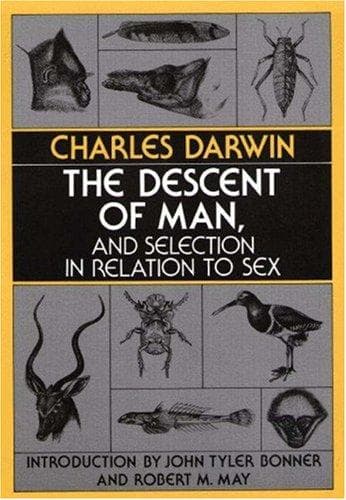
The Descent of Man, and Selection in Relation to SexDarwin, Charles
History
The Descent of Man, and Selection in Relation to Sex
Darwin, Charles
Evolution (Biology); Human beings -- Origin; Sex differences; Sexual dimorphism (Animals); Sexual selection in animals
Why the organs now used for speech should have been originally
perfected for this purpose, rather than any other organs, it is not
difficult to see. Ants have considerable powers of intercommunication
by means of their antennae, as shewn by Huber, who devotes a whole
chapter to their language. We might have used our fingers as efficient
instruments, for a person with practice can report to a deaf man every
word of a speech rapidly delivered at a public meeting; but the loss of
our hands, whilst thus employed, would have been a serious
inconvenience. As all the higher mammals possess vocal organs,
constructed on the same general plan as ours, and used as a means of
communication, it was obviously probable that these same organs would
be still further developed if the power of communication had to be
improved; and this has been effected by the aid of adjoining and well
adapted parts, namely the tongue and lips. (65. See some good remarks
to this effect by Dr. Maudsley, ‘The Physiology and Pathology of Mind,’
1868, p. 199.) The fact of the higher apes not using their vocal organs
for speech, no doubt depends on their intelligence not having been
sufficiently advanced. The possession by them of organs, which with
long-continued practice might have been used for speech, although not
thus used, is paralleled by the case of many birds which possess organs
fitted for singing, though they never sing. Thus, the nightingale and
crow have vocal organs similarly constructed, these being used by the
former for diversified song, and by the latter only for croaking. (66.
Macgillivray, ‘Hist. of British Birds,’ vol. ii. 1839, p. 29. An
excellent observer, Mr. Blackwall, remarks that the magpie learns to
pronounce single words, and even short sentences, more readily than
almost any other British bird; yet, as he adds, after long and closely
investigating its habits, he has never known it, in a state of nature,
display any unusual capacity for imitation. ‘Researches in Zoology,’
1834, p. 158.) If it be asked why apes have not had their intellects
developed to the same degree as that of man, general causes only can be
assigned in answer, and it is unreasonable to expect any thing more
definite, considering our ignorance with respect to the successive
stages of development through which each creature has passed.
Public-domain text, read in full here on John Shaqi.
Reviews
Reviews
No reviews yet
Be the first to share your thoughts on this work.
Elsewhere in the archive
Join the Discussion
Join the discussion
Sign in to leave a comment or review.
Sign InorCreate an account