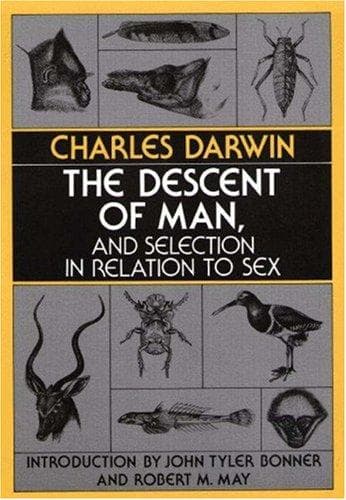
The Descent of Man, and Selection in Relation to SexDarwin, Charles
History
The Descent of Man, and Selection in Relation to Sex
Darwin, Charles
Evolution (Biology); Human beings -- Origin; Sex differences; Sexual dimorphism (Animals); Sexual selection in animals
The perfectly regular and wonderfully complex construction of the
languages of many barbarous nations has often been advanced as a proof,
either of the divine origin of these languages, or of the high art and
former civilisation of their founders. Thus F. von Schlegel writes: “In
those languages which appear to be at the lowest grade of intellectual
culture, we frequently observe a very high and elaborate degree of art
in their grammatical structure. This is especially the case with the
Basque and the Lapponian, and many of the American languages.” (70.
Quoted by C.S. Wake, ‘Chapters on Man,’ 1868, p. 101.) But it is
assuredly an error to speak of any language as an art, in the sense of
its having been elaborately and methodically formed. Philologists now
admit that conjugations, declensions, etc., originally existed as
distinct words, since joined together; and as such words express the
most obvious relations between objects and persons, it is not
surprising that they should have been used by the men of most races
during the earliest ages. With respect to perfection, the following
illustration will best shew how easily we may err: a Crinoid sometimes
consists of no less than 150,000 pieces of shell (71. Buckland,
‘Bridgewater Treatise,’ p. 411.), all arranged with perfect symmetry in
radiating lines; but a naturalist does not consider an animal of this
kind as more perfect than a bilateral one with comparatively few parts,
and with none of these parts alike, excepting on the opposite sides of
the body. He justly considers the differentiation and specialisation of
organs as the test of perfection. So with languages: the most
symmetrical and complex ought not to be ranked above irregular,
abbreviated, and bastardised languages, which have borrowed expressive
words and useful forms of construction from various conquering,
conquered, or immigrant races.
From these few and imperfect remarks I conclude that the extremely
complex and regular construction of many barbarous languages, is no
proof that they owe their origin to a special act of creation. (72. See
some good remarks on the simplification of languages, by Sir J.
Lubbock, ‘Origin of Civilisation,’ 1870, p. 278.) Nor, as we have seen,
does the faculty of articulate speech in itself offer any insuperable
objection to the belief that man has been developed from some lower
form.
SENSE OF BEAUTY.
Public-domain text, read in full here on John Shaqi.
Reviews
Reviews
No reviews yet
Be the first to share your thoughts on this work.
Elsewhere in the archive
Join the Discussion
Join the discussion
Sign in to leave a comment or review.
Sign InorCreate an account