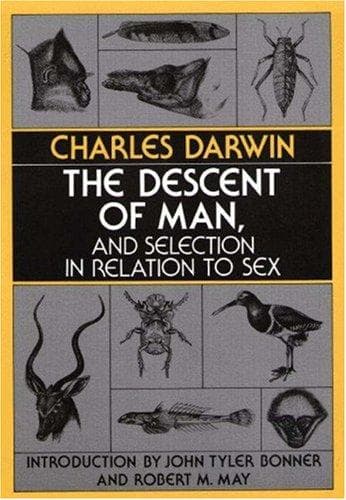
The Descent of Man, and Selection in Relation to SexDarwin, Charles
History
The Descent of Man, and Selection in Relation to Sex
Darwin, Charles
Evolution (Biology); Human beings -- Origin; Sex differences; Sexual dimorphism (Animals); Sexual selection in animals
This sense has been declared to be peculiar to man. I refer here only
to the pleasure given by certain colours, forms, and sounds, and which
may fairly be called a sense of the beautiful; with cultivated men such
sensations are, however, intimately associated with complex ideas and
trains of thought. When we behold a male bird elaborately displaying
his graceful plumes or splendid colours before the female, whilst other
birds, not thus decorated, make no such display, it is impossible to
doubt that she admires the beauty of her male partner. As women
everywhere deck themselves with these plumes, the beauty of such
ornaments cannot be disputed. As we shall see later, the nests of
humming-birds, and the playing passages of bower-birds are tastefully
ornamented with gaily-coloured objects; and this shews that they must
receive some kind of pleasure from the sight of such things. With the
great majority of animals, however, the taste for the beautiful is
confined, as far as we can judge, to the attractions of the opposite
sex. The sweet strains poured forth by many male birds during the
season of love, are certainly admired by the females, of which fact
evidence will hereafter be given. If female birds had been incapable of
appreciating the beautiful colours, the ornaments, and voices of their
male partners, all the labour and anxiety exhibited by the latter in
displaying their charms before the females would have been thrown away;
and this it is impossible to admit. Why certain bright colours should
excite pleasure cannot, I presume, be explained, any more than why
certain flavours and scents are agreeable; but habit has something to
do with the result, for that which is at first unpleasant to our
senses, ultimately becomes pleasant, and habits are inherited. With
respect to sounds, Helmholtz has explained to a certain extent on
physiological principles, why harmonies and certain cadences are
agreeable. But besides this, sounds frequently recurring at irregular
intervals are highly disagreeable, as every one will admit who has
listened at night to the irregular flapping of a rope on board ship.
The same principle seems to come into play with vision, as the eye
prefers symmetry or figures with some regular recurrence. Patterns of
this kind are employed by even the lowest savages as ornaments; and
they have been developed through sexual selection for the adornment of
some male animals. Whether we can or not give any reason for the
pleasure thus derived from vision and hearing, yet man and many of the
lower animals are alike pleased by the same colours, graceful shading
and forms, and the same sounds.
Public-domain text, read in full here on John Shaqi.
Reviews
Reviews
No reviews yet
Be the first to share your thoughts on this work.
Elsewhere in the archive
Join the Discussion
Join the discussion
Sign in to leave a comment or review.
Sign InorCreate an account