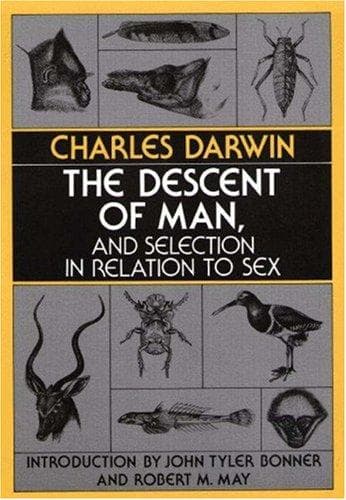
The Descent of Man, and Selection in Relation to SexDarwin, Charles
History
The Descent of Man, and Selection in Relation to Sex
Darwin, Charles
Evolution (Biology); Human beings -- Origin; Sex differences; Sexual dimorphism (Animals); Sexual selection in animals
The taste for the beautiful, at least as far as female beauty is
concerned, is not of a special nature in the human mind; for it differs
widely in the different races of man, and is not quite the same even in
the different nations of the same race. Judging from the hideous
ornaments, and the equally hideous music admired by most savages, it
might be urged that their aesthetic faculty was not so highly developed
as in certain animals, for instance, as in birds. Obviously no animal
would be capable of admiring such scenes as the heavens at night, a
beautiful landscape, or refined music; but such high tastes are
acquired through culture, and depend on complex associations; they are
not enjoyed by barbarians or by uneducated persons.
Many of the faculties, which have been of inestimable service to man
for his progressive advancement, such as the powers of the imagination,
wonder, curiosity, an undefined sense of beauty, a tendency to
imitation, and the love of excitement or novelty, could hardly fail to
lead to capricious changes of customs and fashions. I have alluded to
this point, because a recent writer (73. ‘The Spectator,’ Dec. 4th,
1869, p. 1430.) has oddly fixed on Caprice “as one of the most
remarkable and typical differences between savages and brutes.” But not
only can we partially understand how it is that man is from various
conflicting influences rendered capricious, but that the lower animals
are, as we shall hereafter see, likewise capricious in their
affections, aversions, and sense of beauty. There is also reason to
suspect that they love novelty, for its own sake.
BELIEF IN GOD—RELIGION.
There is no evidence that man was aboriginally endowed with the
ennobling belief in the existence of an Omnipotent God. On the contrary
there is ample evidence, derived not from hasty travellers, but from
men who have long resided with savages, that numerous races have
existed, and still exist, who have no idea of one or more gods, and who
have no words in their languages to express such an idea. (74. See an
excellent article on this subject by the Rev. F.W. Farrar, in the
‘Anthropological Review,’ Aug. 1864, p. ccxvii. For further facts see
Sir J. Lubbock, ‘Prehistoric Times,’ 2nd edit., 1869, p. 564; and
especially the chapters on Religion in his ‘Origin of Civilisation,’
1870.) The question is of course wholly distinct from that higher one,
whether there exists a Creator and Ruler of the universe; and this has
been answered in the affirmative by some of the highest intellects that
have ever existed.
Public-domain text, read in full here on John Shaqi.
Reviews
Reviews
No reviews yet
Be the first to share your thoughts on this work.
Elsewhere in the archive
Join the Discussion
Join the discussion
Sign in to leave a comment or review.
Sign InorCreate an account