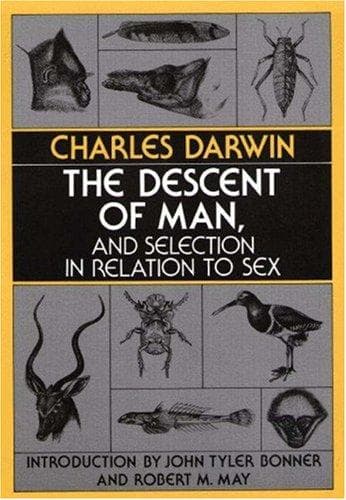
The Descent of Man, and Selection in Relation to SexDarwin, Charles
History
The Descent of Man, and Selection in Relation to Sex
Darwin, Charles
Evolution (Biology); Human beings -- Origin; Sex differences; Sexual dimorphism (Animals); Sexual selection in animals
The tendency in savages to imagine that natural objects and agencies
are animated by spiritual or living essences, is perhaps illustrated by
a little fact which I once noticed: my dog, a full-grown and very
sensible animal, was lying on the lawn during a hot and still day; but
at a little distance a slight breeze occasionally moved an open
parasol, which would have been wholly disregarded by the dog, had any
one stood near it. As it was, every time that the parasol slightly
moved, the dog growled fiercely and barked. He must, I think, have
reasoned to himself in a rapid and unconscious manner, that movement
without any apparent cause indicated the presence of some strange
living agent, and that no stranger had a right to be on his territory.
The belief in spiritual agencies would easily pass into the belief in
the existence of one or more gods. For savages would naturally
attribute to spirits the same passions, the same love of vengeance or
simplest form of justice, and the same affections which they themselves
feel. The Fuegians appear to be in this respect in an intermediate
condition, for when the surgeon on board the “Beagle” shot some young
ducklings as specimens, York Minster declared in the most solemn
manner, “Oh, Mr. Bynoe, much rain, much snow, blow much”; and this was
evidently a retributive punishment for wasting human food. So again he
related how, when his brother killed a “wild man,” storms long raged,
much rain and snow fell. Yet we could never discover that the Fuegians
believed in what we should call a God, or practised any religious
rites; and Jemmy Button, with justifiable pride, stoutly maintained
that there was no devil in his land. This latter assertion is the more
remarkable, as with savages the belief in bad spirits is far more
common than that in good ones.
Public-domain text, read in full here on John Shaqi.
Reviews
Reviews
No reviews yet
Be the first to share your thoughts on this work.
Elsewhere in the archive
Join the Discussion
Join the discussion
Sign in to leave a comment or review.
Sign InorCreate an account