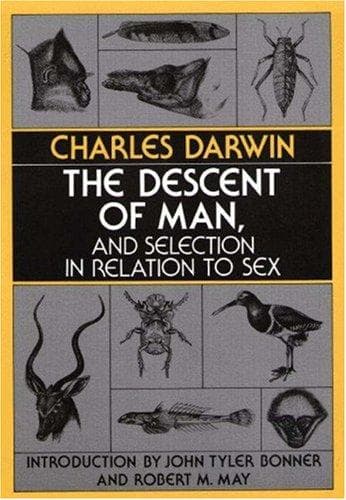
The Descent of Man, and Selection in Relation to SexDarwin, Charles
History
The Descent of Man, and Selection in Relation to Sex
Darwin, Charles
Evolution (Biology); Human beings -- Origin; Sex differences; Sexual dimorphism (Animals); Sexual selection in animals
The feeling of religious devotion is a highly complex one, consisting
of love, complete submission to an exalted and mysterious superior, a
strong sense of dependence (77. See an able article on the ‘Physical
Elements of Religion,’ by Mr. L. Owen Pike, in ‘Anthropological
Review,’ April 1870, p. lxiii.), fear, reverence, gratitude, hope for
the future, and perhaps other elements. No being could experience so
complex an emotion until advanced in his intellectual and moral
faculties to at least a moderately high level. Nevertheless, we see
some distant approach to this state of mind in the deep love of a dog
for his master, associated with complete submission, some fear, and
perhaps other feelings. The behaviour of a dog when returning to his
master after an absence, and, as I may add, of a monkey to his beloved
keeper, is widely different from that towards their fellows. In the
latter case the transports of joy appear to be somewhat less, and the
sense of equality is shewn in every action. Professor Braubach goes so
far as to maintain that a dog looks on his master as on a god. (78.
‘Religion, Moral, etc., der Darwin’schen Art-Lehre,’ 1869, s. 53. It is
said (Dr. W. Lauder Lindsay, ‘Journal of Mental Science,’ 1871, p. 43),
that Bacon long ago, and the poet Burns, held the same notion.)
The same high mental faculties which first led man to believe in unseen
spiritual agencies, then in fetishism, polytheism, and ultimately in
monotheism, would infallibly lead him, as long as his reasoning powers
remained poorly developed, to various strange superstitions and
customs. Many of these are terrible to think of—such as the sacrifice
of human beings to a blood-loving god; the trial of innocent persons by
the ordeal of poison or fire; witchcraft, etc.—yet it is well
occasionally to reflect on these superstitions, for they shew us what
an infinite debt of gratitude we owe to the improvement of our reason,
to science, and to our accumulated knowledge. As Sir J. Lubbock (79.
‘Prehistoric Times,’ 2nd edit., p. 571. In this work (p. 571) there
will be found an excellent account of the many strange and capricious
customs of savages.) has well observed, “it is not too much to say that
the horrible dread of unknown evil hangs like a thick cloud over savage
life, and embitters every pleasure.” These miserable and indirect
consequences of our highest faculties may be compared with the
incidental and occasional mistakes of the instincts of the lower
animals.
CHAPTER IV.
COMPARISON OF THE MENTAL POWERS OF MAN AND THE LOWER ANIMALS—continued.
Public-domain text, read in full here on John Shaqi.
Reviews
Reviews
No reviews yet
Be the first to share your thoughts on this work.
Elsewhere in the archive
Join the Discussion
Join the discussion
Sign in to leave a comment or review.
Sign InorCreate an account