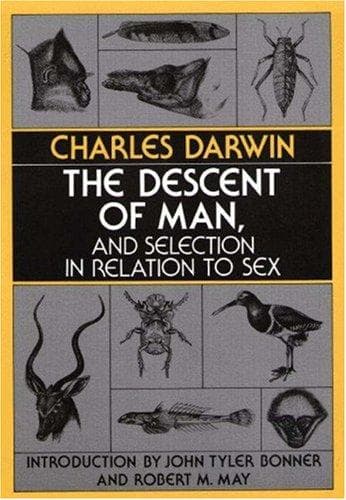
The Descent of Man, and Selection in Relation to SexDarwin, Charles
History
The Descent of Man, and Selection in Relation to Sex
Darwin, Charles
Evolution (Biology); Human beings -- Origin; Sex differences; Sexual dimorphism (Animals); Sexual selection in animals
The following proposition seems to me in a high degree probable—namely,
that any animal whatever, endowed with well-marked social instincts (5.
Sir B. Brodie, after observing that man is a social animal
(‘Psychological Enquiries,’ 1854, p. 192), asks the pregnant question,
“ought not this to settle the disputed question as to the existence of
a moral sense?” Similar ideas have probably occurred to many persons,
as they did long ago to Marcus Aurelius. Mr. J.S. Mill speaks, in his
celebrated work, ‘Utilitarianism,’ (1864, pp. 45, 46), of the social
feelings as a “powerful natural sentiment,” and as “the natural basis
of sentiment for utilitarian morality.” Again he says, “Like the other
acquired capacities above referred to, the moral faculty, if not a part
of our nature, is a natural out-growth from it; capable, like them, in
a certain small degree of springing up spontaneously.” But in
opposition to all this, he also remarks, “if, as in my own belief, the
moral feelings are not innate, but acquired, they are not for that
reason less natural.” It is with hesitation that I venture to differ at
all from so profound a thinker, but it can hardly be disputed that the
social feelings are instinctive or innate in the lower animals; and why
should they not be so in man? Mr. Bain (see, for instance, ‘The
Emotions and the Will,’ 1865, p. 481) and others believe that the moral
sense is acquired by each individual during his lifetime. On the
general theory of evolution this is at least extremely improbable. The
ignoring of all transmitted mental qualities will, as it seems to me,
be hereafter judged as a most serious blemish in the works of Mr.
Mill.), the parental and filial affections being here included, would
inevitably acquire a moral sense or conscience, as soon as its
intellectual powers had become as well, or nearly as well developed, as
in man. For, FIRSTLY, the social instincts lead an animal to take
pleasure in the society of its fellows, to feel a certain amount of
sympathy with them, and to perform various services for them. The
services may be of a definite and evidently instinctive nature; or
there may be only a wish and readiness, as with most of the higher
social animals, to aid their fellows in certain general ways. But these
feelings and services are by no means extended to all the individuals
of the same species, only to those of the same association. SECONDLY,
as soon as the mental faculties had become highly developed, images of
all past actions and motives would be incessantly passing through the
brain of each individual: and that feeling of dissatisfaction, or even
misery, which invariably results, as we shall hereafter see, from any
unsatisfied instinct, would arise, as often as it was perceived that
the enduring and always present social instinct had yielded to some
other instinct, at the time stronger, but neither enduring in its
nature, nor leaving behind it a very vivid impression. It is clear that
Public-domain text, read in full here on John Shaqi.
Reviews
Reviews
No reviews yet
Be the first to share your thoughts on this work.
Elsewhere in the archive
Join the Discussion
Join the discussion
Sign in to leave a comment or review.
Sign InorCreate an account