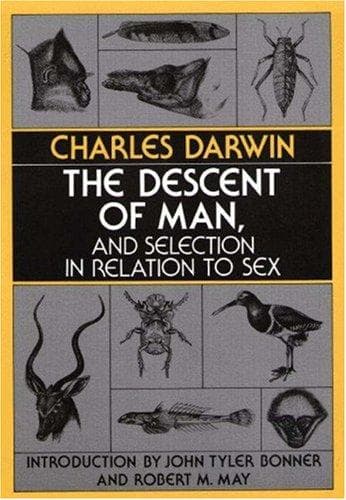
The Descent of Man, and Selection in Relation to SexDarwin, Charles
History
The Descent of Man, and Selection in Relation to Sex
Darwin, Charles
Evolution (Biology); Human beings -- Origin; Sex differences; Sexual dimorphism (Animals); Sexual selection in animals
many instinctive desires, such as that of hunger, are in their nature
of short duration; and after being satisfied, are not readily or
vividly recalled. THIRDLY, after the power of language had been
acquired, and the wishes of the community could be expressed, the
common opinion how each member ought to act for the public good, would
naturally become in a paramount degree the guide to action. But it
should be borne in mind that however great weight we may attribute to
public opinion, our regard for the approbation and disapprobation of
our fellows depends on sympathy, which, as we shall see, forms an
essential part of the social instinct, and is indeed its
foundation-stone. LASTLY, habit in the individual would ultimately play
a very important part in guiding the conduct of each member; for the
social instinct, together with sympathy, is, like any other instinct,
greatly strengthened by habit, and so consequently would be obedience
to the wishes and judgment of the community. These several subordinate
propositions must now be discussed, and some of them at considerable
length.
It may be well first to premise that I do not wish to maintain that any
strictly social animal, if its intellectual faculties were to become as
active and as highly developed as in man, would acquire exactly the
same moral sense as ours. In the same manner as various animals have
some sense of beauty, though they admire widely-different objects, so
they might have a sense of right and wrong, though led by it to follow
widely different lines of conduct. If, for instance, to take an extreme
case, men were reared under precisely the same conditions as hive-bees,
there can hardly be a doubt that our unmarried females would, like the
worker-bees, think it a sacred duty to kill their brothers, and mothers
would strive to kill their fertile daughters; and no one would think of
interfering. (6. Mr. H. Sidgwick remarks, in an able discussion on this
subject (the ‘Academy,’ June 15, 1872, p. 231), “a superior bee, we may
feel sure, would aspire to a milder solution of the population
question.” Judging, however, from the habits of many or most savages,
man solves the problem by female infanticide, polyandry and promiscuous
intercourse; therefore it may well be doubted whether it would be by a
milder method. Miss Cobbe, in commenting (‘Darwinism in Morals,’
‘Theological Review,’ April 1872, pp. 188-191) on the same
illustration, says, the PRINCIPLES of social duty would be thus
reversed; and by this, I presume, she means that the fulfilment of a
social duty would tend to the injury of individuals; but she overlooks
the fact, which she would doubtless admit, that the instincts of the
bee have been acquired for the good of the community. She goes so far
as to say that if the theory of ethics advocated in this chapter were
ever generally accepted, “I cannot but believe that in the hour of
their triumph would be sounded the knell of the virtue of mankind!” It
Public-domain text, read in full here on John Shaqi.
Reviews
Reviews
No reviews yet
Be the first to share your thoughts on this work.
Elsewhere in the archive
Join the Discussion
Join the discussion
Sign in to leave a comment or review.
Sign InorCreate an account