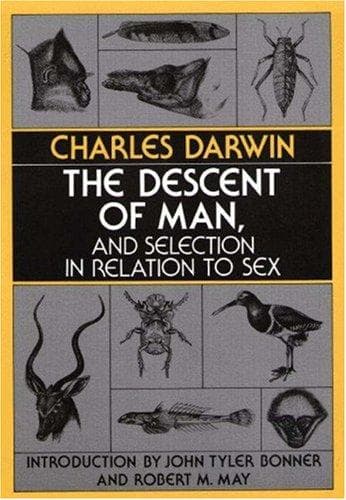
The Descent of Man, and Selection in Relation to SexDarwin, Charles
History
The Descent of Man, and Selection in Relation to Sex
Darwin, Charles
Evolution (Biology); Human beings -- Origin; Sex differences; Sexual dimorphism (Animals); Sexual selection in animals
is to be hoped that the belief in the permanence of virtue on this
earth is not held by many persons on so weak a tenure.) Nevertheless,
the bee, or any other social animal, would gain in our supposed case,
as it appears to me, some feeling of right or wrong, or a conscience.
For each individual would have an inward sense of possessing certain
stronger or more enduring instincts, and others less strong or
enduring; so that there would often be a struggle as to which impulse
should be followed; and satisfaction, dissatisfaction, or even misery
would be felt, as past impressions were compared during their incessant
passage through the mind. In this case an inward monitor would tell the
animal that it would have been better to have followed the one impulse
rather than the other. The one course ought to have been followed, and
the other ought not; the one would have been right and the other wrong;
but to these terms I shall recur.
SOCIABILITY.
Animals of many kinds are social; we find even distinct species living
together; for example, some American monkeys; and united flocks of
rooks, jackdaws, and starlings. Man shews the same feeling in his
strong love for the dog, which the dog returns with interest. Every one
must have noticed how miserable horses, dogs, sheep, etc., are when
separated from their companions, and what strong mutual affection the
two former kinds, at least, shew on their reunion. It is curious to
speculate on the feelings of a dog, who will rest peacefully for hours
in a room with his master or any of the family, without the least
notice being taken of him; but if left for a short time by himself,
barks or howls dismally. We will confine our attention to the higher
social animals; and pass over insects, although some of these are
social, and aid one another in many important ways. The most common
mutual service in the higher animals is to warn one another of danger
by means of the united senses of all. Every sportsman knows, as Dr.
Jaeger remarks (7. ‘Die Darwin’sche Theorie,’ s. 101.), how difficult
it is to approach animals in a herd or troop. Wild horses and cattle do
not, I believe, make any danger-signal; but the attitude of any one of
them who first discovers an enemy, warns the others. Rabbits stamp
loudly on the ground with their hind-feet as a signal: sheep and
chamois do the same with their forefeet, uttering likewise a whistle.
Many birds, and some mammals, post sentinels, which in the case of
seals are said (8. Mr. R. Brown in ‘Proc. Zoolog. Soc.’ 1868, p. 409.)
generally to be the females. The leader of a troop of monkeys acts as
the sentinel, and utters cries expressive both of danger and of safety.
(9. Brehm, ‘Thierleben,’ B. i. 1864, s. 52, 79. For the case of the
monkeys extracting thorns from each other, see s. 54. With respect to
the Hamadryas turning over stones, the fact is given (s. 76), on the
evidence of Alvarez, whose observations Brehm thinks quite trustworthy.
Public-domain text, read in full here on John Shaqi.
Reviews
Reviews
No reviews yet
Be the first to share your thoughts on this work.
Elsewhere in the archive
Join the Discussion
Join the discussion
Sign in to leave a comment or review.
Sign InorCreate an account