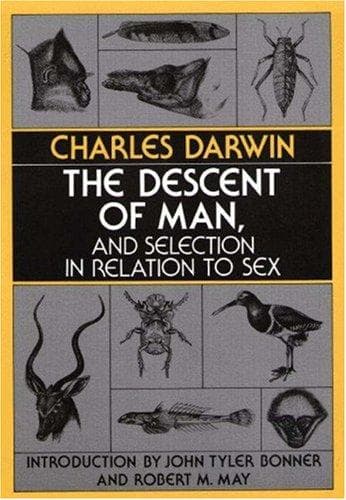
The Descent of Man, and Selection in Relation to SexDarwin, Charles
History
The Descent of Man, and Selection in Relation to Sex
Darwin, Charles
Evolution (Biology); Human beings -- Origin; Sex differences; Sexual dimorphism (Animals); Sexual selection in animals
The all-important emotion of sympathy is distinct from that of love. A
mother may passionately love her sleeping and passive infant, but she
can hardly at such times be said to feel sympathy for it. The love of a
man for his dog is distinct from sympathy, and so is that of a dog for
his master. Adam Smith formerly argued, as has Mr. Bain recently, that
the basis of sympathy lies in our strong retentiveness of former states
of pain or pleasure. Hence, “the sight of another person enduring
hunger, cold, fatigue, revives in us some recollection of these states,
which are painful even in idea.” We are thus impelled to relieve the
sufferings of another, in order that our own painful feelings may be at
the same time relieved. In like manner we are led to participate in the
pleasures of others. (21. See the first and striking chapter in Adam
Smith’s ‘Theory of Moral Sentiments.’ Also ‘Mr. Bain’s Mental and Moral
Science,’ 1868, pp. 244, and 275-282. Mr. Bain states, that, “sympathy
is, indirectly, a source of pleasure to the sympathiser”; and he
accounts for this through reciprocity. He remarks that “the person
benefited, or others in his stead, may make up, by sympathy and good
offices returned, for all the sacrifice.” But if, as appears to be the
case, sympathy is strictly an instinct, its exercise would give direct
pleasure, in the same manner as the exercise, as before remarked, of
almost every other instinct.) But I cannot see how this view explains
the fact that sympathy is excited, in an immeasurably stronger degree,
by a beloved, than by an indifferent person. The mere sight of
suffering, independently of love, would suffice to call up in us vivid
recollections and associations. The explanation may lie in the fact
that, with all animals, sympathy is directed solely towards the members
of the same community, and therefore towards known, and more or less
beloved members, but not to all the individuals of the same species.
This fact is not more surprising than that the fears of many animals
should be directed against special enemies. Species which are not
social, such as lions and tigers, no doubt feel sympathy for the
suffering of their own young, but not for that of any other animal.
With mankind, selfishness, experience, and imitation, probably add, as
Mr. Bain has shewn, to the power of sympathy; for we are led by the
hope of receiving good in return to perform acts of sympathetic
kindness to others; and sympathy is much strengthened by habit. In
however complex a manner this feeling may have originated, as it is one
of high importance to all those animals which aid and defend one
another, it will have been increased through natural selection; for
those communities, which included the greatest number of the most
sympathetic members, would flourish best, and rear the greatest number
of offspring.
Public-domain text, read in full here on John Shaqi.
Reviews
Reviews
No reviews yet
Be the first to share your thoughts on this work.
Elsewhere in the archive
Join the Discussion
Join the discussion
Sign in to leave a comment or review.
Sign InorCreate an account