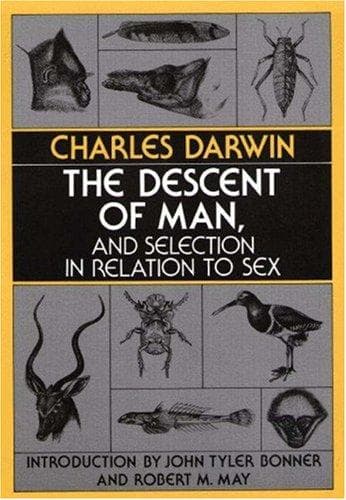
The Descent of Man, and Selection in Relation to SexDarwin, Charles
History
The Descent of Man, and Selection in Relation to Sex
Darwin, Charles
Evolution (Biology); Human beings -- Origin; Sex differences; Sexual dimorphism (Animals); Sexual selection in animals
It is, however, impossible to decide in many cases whether certain
social instincts have been acquired through natural selection, or are
the indirect result of other instincts and faculties, such as sympathy,
reason, experience, and a tendency to imitation; or again, whether they
are simply the result of long-continued habit. So remarkable an
instinct as the placing sentinels to warn the community of danger, can
hardly have been the indirect result of any of these faculties; it
must, therefore, have been directly acquired. On the other hand, the
habit followed by the males of some social animals of defending the
community, and of attacking their enemies or their prey in concert, may
perhaps have originated from mutual sympathy; but courage, and in most
cases strength, must have been previously acquired, probably through
natural selection.
Of the various instincts and habits, some are much stronger than
others; that is, some either give more pleasure in their performance,
and more distress in their prevention, than others; or, which is
probably quite as important, they are, through inheritance, more
persistently followed, without exciting any special feeling of pleasure
or pain. We are ourselves conscious that some habits are much more
difficult to cure or change than others. Hence a struggle may often be
observed in animals between different instincts, or between an instinct
and some habitual disposition; as when a dog rushes after a hare, is
rebuked, pauses, hesitates, pursues again, or returns ashamed to his
master; or as between the love of a female dog for her young puppies
and for her master,—for she may be seen to slink away to them, as if
half ashamed of not accompanying her master. But the most curious
instance known to me of one instinct getting the better of another, is
the migratory instinct conquering the maternal instinct. The former is
wonderfully strong; a confined bird will at the proper season beat her
breast against the wires of her cage, until it is bare and bloody. It
causes young salmon to leap out of the fresh water, in which they could
continue to exist, and thus unintentionally to commit suicide. Every
one knows how strong the maternal instinct is, leading even timid birds
to face great danger, though with hesitation, and in opposition to the
instinct of self-preservation. Nevertheless, the migratory instinct is
so powerful, that late in the autumn swallows, house-martins, and
swifts frequently desert their tender young, leaving them to perish
miserably in their nests. (22. This fact, the Rev. L. Jenyns states
(see his edition of ‘White’s Nat. Hist. of Selborne,’ 1853, p. 204) was
first recorded by the illustrious Jenner, in ‘Phil. Transact.’ 1824,
and has since been confirmed by several observers, especially by Mr.
Blackwall. This latter careful observer examined, late in the autumn,
during two years, thirty-six nests; he found that twelve contained
young dead birds, five contained eggs on the point of being hatched,
Public-domain text, read in full here on John Shaqi.
Reviews
Reviews
No reviews yet
Be the first to share your thoughts on this work.
Elsewhere in the archive
Join the Discussion
Join the discussion
Sign in to leave a comment or review.
Sign InorCreate an account