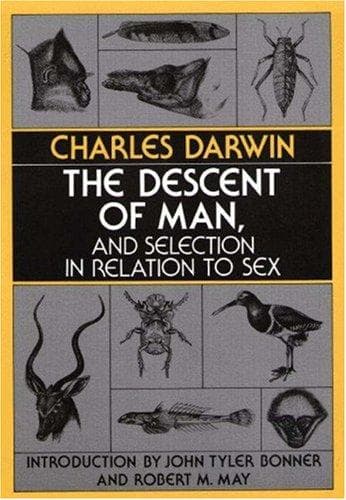
The Descent of Man, and Selection in Relation to SexDarwin, Charles
History
The Descent of Man, and Selection in Relation to Sex
Darwin, Charles
Evolution (Biology); Human beings -- Origin; Sex differences; Sexual dimorphism (Animals); Sexual selection in animals
together with sympathy, should have been highly cultivated and extended
by the aid of reason, instruction, and the love or fear of God, before
any such golden rule would ever be thought of and obeyed.)
A man cannot prevent past impressions often repassing through his mind;
he will thus be driven to make a comparison between the impressions of
past hunger, vengeance satisfied, or danger shunned at other men’s
cost, with the almost ever-present instinct of sympathy, and with his
early knowledge of what others consider as praiseworthy or blameable.
This knowledge cannot be banished from his mind, and from instinctive
sympathy is esteemed of great moment. He will then feel as if he had
been baulked in following a present instinct or habit, and this with
all animals causes dissatisfaction, or even misery.
The above case of the swallow affords an illustration, though of a
reversed nature, of a temporary though for the time strongly persistent
instinct conquering another instinct, which is usually dominant over
all others. At the proper season these birds seem all day long to be
impressed with the desire to migrate; their habits change; they become
restless, are noisy and congregate in flocks. Whilst the mother-bird is
feeding, or brooding over her nestlings, the maternal instinct is
probably stronger than the migratory; but the instinct which is the
more persistent gains the victory, and at last, at a moment when her
young ones are not in sight, she takes flight and deserts them. When
arrived at the end of her long journey, and the migratory instinct has
ceased to act, what an agony of remorse the bird would feel, if, from
being endowed with great mental activity, she could not prevent the
image constantly passing through her mind, of her young ones perishing
in the bleak north from cold and hunger.
At the moment of action, man will no doubt be apt to follow the
stronger impulse; and though this may occasionally prompt him to the
noblest deeds, it will more commonly lead him to gratify his own
desires at the expense of other men. But after their gratification when
past and weaker impressions are judged by the ever-enduring social
instinct, and by his deep regard for the good opinion of his fellows,
retribution will surely come. He will then feel remorse, repentance,
regret, or shame; this latter feeling, however, relates almost
exclusively to the judgment of others. He will consequently resolve
more or less firmly to act differently for the future; and this is
conscience; for conscience looks backwards, and serves as a guide for
the future.
Public-domain text, read in full here on John Shaqi.
Reviews
Reviews
No reviews yet
Be the first to share your thoughts on this work.
Elsewhere in the archive
Join the Discussion
Join the discussion
Sign in to leave a comment or review.
Sign InorCreate an account