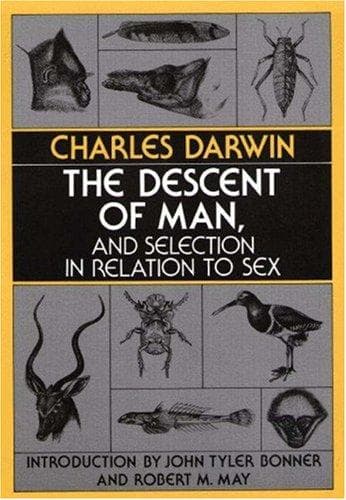
The Descent of Man, and Selection in Relation to SexDarwin, Charles
History
The Descent of Man, and Selection in Relation to Sex
Darwin, Charles
Evolution (Biology); Human beings -- Origin; Sex differences; Sexual dimorphism (Animals); Sexual selection in animals
Man, from the activity of his mental faculties, cannot avoid
reflection: past impressions and images are incessantly and clearly
passing through his mind. Now with those animals which live permanently
in a body, the social instincts are ever present and persistent. Such
animals are always ready to utter the danger-signal, to defend the
community, and to give aid to their fellows in accordance with their
habits; they feel at all times, without the stimulus of any special
passion or desire, some degree of love and sympathy for them; they are
unhappy if long separated from them, and always happy to be again in
their company. So it is with ourselves. Even when we are quite alone,
how often do we think with pleasure or pain of what others think of
us,—of their imagined approbation or disapprobation; and this all
follows from sympathy, a fundamental element of the social instincts. A
man who possessed no trace of such instincts would be an unnatural
monster. On the other hand, the desire to satisfy hunger, or any
passion such as vengeance, is in its nature temporary, and can for a
time be fully satisfied. Nor is it easy, perhaps hardly possible, to
call up with complete vividness the feeling, for instance, of hunger;
nor indeed, as has often been remarked, of any suffering. The instinct
of self-preservation is not felt except in the presence of danger; and
many a coward has thought himself brave until he has met his enemy face
to face. The wish for another man’s property is perhaps as persistent a
desire as any that can be named; but even in this case the satisfaction
of actual possession is generally a weaker feeling than the desire:
many a thief, if not a habitual one, after success has wondered why he
stole some article. (27. Enmity or hatred seems also to be a highly
persistent feeling, perhaps more so than any other that can be named.
Envy is defined as hatred of another for some excellence or success;
and Bacon insists (Essay ix.), “Of all other affections envy is the
most importune and continual.” Dogs are very apt to hate both strange
men and strange dogs, especially if they live near at hand, but do not
belong to the same family, tribe, or clan; this feeling would thus seem
to be innate, and is certainly a most persistent one. It seems to be
the complement and converse of the true social instinct. From what we
hear of savages, it would appear that something of the same kind holds
good with them. If this be so, it would be a small step in any one to
transfer such feelings to any member of the same tribe if he had done
him an injury and had become his enemy. Nor is it probable that the
primitive conscience would reproach a man for injuring his enemy;
rather it would reproach him, if he had not revenged himself. To do
good in return for evil, to love your enemy, is a height of morality to
which it may be doubted whether the social instincts would, by
themselves, have ever led us. It is necessary that these instincts,
Public-domain text, read in full here on John Shaqi.
Reviews
Reviews
No reviews yet
Be the first to share your thoughts on this work.
Elsewhere in the archive
Join the Discussion
Join the discussion
Sign in to leave a comment or review.
Sign InorCreate an account