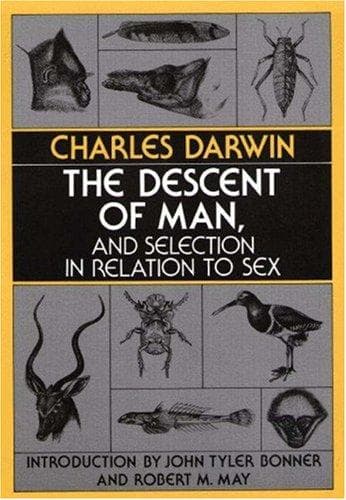
The Descent of Man, and Selection in Relation to SexDarwin, Charles
History
The Descent of Man, and Selection in Relation to Sex
Darwin, Charles
Evolution (Biology); Human beings -- Origin; Sex differences; Sexual dimorphism (Animals); Sexual selection in animals
The above view of the origin and nature of the moral sense, which tells
us what we ought to do, and of the conscience which reproves us if we
disobey it, accords well with what we see of the early and undeveloped
condition of this faculty in mankind. The virtues which must be
practised, at least generally, by rude men, so that they may associate
in a body, are those which are still recognised as the most important.
But they are practised almost exclusively in relation to the men of the
same tribe; and their opposites are not regarded as crimes in relation
to the men of other tribes. No tribe could hold together if murder,
robbery, treachery, etc., were common; consequently such crimes within
the limits of the same tribe “are branded with everlasting infamy” (31.
See an able article in the ‘North British Review,’ 1867, p. 395. See
also Mr. W. Bagehot’s articles on the Importance of Obedience and
Coherence to Primitive Man, in the ‘Fortnightly Review,’ 1867, p. 529,
and 1868, p. 457, etc.); but excite no such sentiment beyond these
limits. A North-American Indian is well pleased with himself, and is
honoured by others, when he scalps a man of another tribe; and a Dyak
cuts off the head of an unoffending person, and dries it as a trophy.
The murder of infants has prevailed on the largest scale throughout the
world (32. The fullest account which I have met with is by Dr. Gerland,
in his ‘Ueber den Aussterben der Naturvölker,’ 1868; but I shall have
to recur to the subject of infanticide in a future chapter.), and has
met with no reproach; but infanticide, especially of females, has been
thought to be good for the tribe, or at least not injurious. Suicide
during former times was not generally considered as a crime (33. See
the very interesting discussion on suicide in Lecky’s ‘History of
European Morals,’ vol. i. 1869, p. 223. With respect to savages, Mr.
Winwood Reade informs me that the negroes of West Africa often commit
suicide. It is well known how common it was amongst the miserable
aborigines of South America after the Spanish conquest. For New
Zealand, see the voyage of the Novara, and for the Aleutian Islands,
Müller, as quoted by Houzeau, ‘Les Facultés Mentales,’ etc., tom. ii.
p. 136.), but rather, from the courage displayed, as an honourable act;
and it is still practised by some semi-civilised and savage nations
without reproach, for it does not obviously concern others of the
tribe. It has been recorded that an Indian Thug conscientiously
regretted that he had not robbed and strangled as many travellers as
did his father before him. In a rude state of civilisation the robbery
of strangers is, indeed, generally considered as honourable.
Public-domain text, read in full here on John Shaqi.
Reviews
Reviews
No reviews yet
Be the first to share your thoughts on this work.
Elsewhere in the archive
Join the Discussion
Join the discussion
Sign in to leave a comment or review.
Sign InorCreate an account