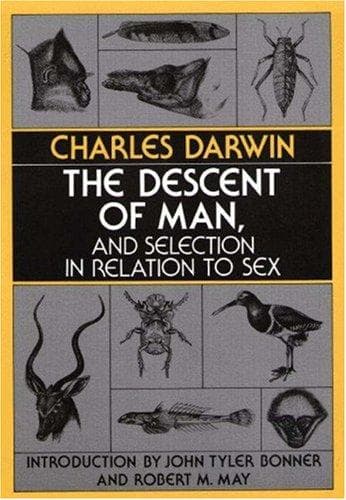
The Descent of Man, and Selection in Relation to SexDarwin, Charles
History
The Descent of Man, and Selection in Relation to Sex
Darwin, Charles
Evolution (Biology); Human beings -- Origin; Sex differences; Sexual dimorphism (Animals); Sexual selection in animals
Slavery, although in some ways beneficial during ancient times (34. See
Mr. Bagehot, ‘Physics and Politics,’ 1872, p. 72.), is a great crime;
yet it was not so regarded until quite recently, even by the most
civilised nations. And this was especially the case, because the slaves
belonged in general to a race different from that of their masters. As
barbarians do not regard the opinion of their women, wives are commonly
treated like slaves. Most savages are utterly indifferent to the
sufferings of strangers, or even delight in witnessing them. It is well
known that the women and children of the North-American Indians aided
in torturing their enemies. Some savages take a horrid pleasure in
cruelty to animals (35. See, for instance, Mr. Hamilton’s account of
the Kaffirs, ‘Anthropological Review,’ 1870, p. xv.), and humanity is
an unknown virtue. Nevertheless, besides the family affections,
kindness is common, especially during sickness, between the members of
the same tribe, and is sometimes extended beyond these limits. Mungo
Park’s touching account of the kindness of the negro women of the
interior to him is well known. Many instances could be given of the
noble fidelity of savages towards each other, but not to strangers;
common experience justifies the maxim of the Spaniard, “Never, never
trust an Indian.” There cannot be fidelity without truth; and this
fundamental virtue is not rare between the members of the same tribe:
thus Mungo Park heard the negro women teaching their young children to
love the truth. This, again, is one of the virtues which becomes so
deeply rooted in the mind, that it is sometimes practised by savages,
even at a high cost, towards strangers; but to lie to your enemy has
rarely been thought a sin, as the history of modern diplomacy too
plainly shews. As soon as a tribe has a recognised leader, disobedience
becomes a crime, and even abject submission is looked at as a sacred
virtue.
As during rude times no man can be useful or faithful to his tribe
without courage, this quality has universally been placed in the
highest rank; and although in civilised countries a good yet timid man
may be far more useful to the community than a brave one, we cannot
help instinctively honouring the latter above a coward, however
benevolent. Prudence, on the other hand, which does not concern the
welfare of others, though a very useful virtue, has never been highly
esteemed. As no man can practise the virtues necessary for the welfare
of his tribe without self-sacrifice, self-command, and the power of
endurance, these qualities have been at all times highly and most
justly valued. The American savage voluntarily submits to the most
horrid tortures without a groan, to prove and strengthen his fortitude
and courage; and we cannot help admiring him, or even an Indian Fakir,
who, from a foolish religious motive, swings suspended by a hook buried
in his flesh.
Public-domain text, read in full here on John Shaqi.
Reviews
Reviews
No reviews yet
Be the first to share your thoughts on this work.
Elsewhere in the archive
Join the Discussion
Join the discussion
Sign in to leave a comment or review.
Sign InorCreate an account