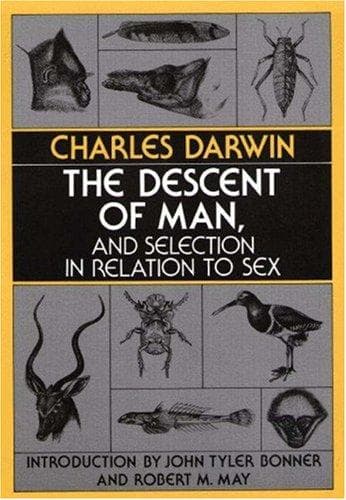
The Descent of Man, and Selection in Relation to SexDarwin, Charles
History
The Descent of Man, and Selection in Relation to Sex
Darwin, Charles
Evolution (Biology); Human beings -- Origin; Sex differences; Sexual dimorphism (Animals); Sexual selection in animals
Finally the social instincts, which no doubt were acquired by man as by
the lower animals for the good of the community, will from the first
have given to him some wish to aid his fellows, some feeling of
sympathy, and have compelled him to regard their approbation and
disapprobation. Such impulses will have served him at a very early
period as a rude rule of right and wrong. But as man gradually advanced
in intellectual power, and was enabled to trace the more remote
consequences of his actions; as he acquired sufficient knowledge to
reject baneful customs and superstitions; as he regarded more and more,
not only the welfare, but the happiness of his fellow-men; as from
habit, following on beneficial experience, instruction and example, his
sympathies became more tender and widely diffused, extending to men of
all races, to the imbecile, maimed, and other useless members of
society, and finally to the lower animals,—so would the standard of his
morality rise higher and higher. And it is admitted by moralists of the
derivative school and by some intuitionists, that the standard of
morality has risen since an early period in the history of man. (48. A
writer in the ‘North British Review’ (July 1869, p. 531), well capable
of forming a sound judgment, expresses himself strongly in favour of
this conclusion. Mr. Lecky (‘History of Morals,’ vol. i. p. 143) seems
to a certain extent to coincide therein.)
As a struggle may sometimes be seen going on between the various
instincts of the lower animals, it is not surprising that there should
be a struggle in man between his social instincts, with their derived
virtues, and his lower, though momentarily stronger impulses or
desires. This, as Mr. Galton (49. See his remarkable work on
‘Hereditary Genius,’ 1869, p. 349. The Duke of Argyll (‘Primeval Man,’
1869, p. 188) has some good remarks on the contest in man’s nature
between right and wrong.) has remarked, is all the less surprising, as
man has emerged from a state of barbarism within a comparatively recent
period. After having yielded to some temptation we feel a sense of
dissatisfaction, shame, repentance, or remorse, analogous to the
feelings caused by other powerful instincts or desires, when left
unsatisfied or baulked. We compare the weakened impression of a past
temptation with the ever present social instincts, or with habits,
gained in early youth and strengthened during our whole lives, until
they have become almost as strong as instincts. If with the temptation
still before us we do not yield, it is because either the social
instinct or some custom is at the moment predominant, or because we
have learnt that it will appear to us hereafter the stronger, when
compared with the weakened impression of the temptation, and we realise
that its violation would cause us suffering. Looking to future
generations, there is no cause to fear that the social instincts will
grow weaker, and we may expect that virtuous habits will grow stronger,
Public-domain text, read in full here on John Shaqi.
Reviews
Reviews
No reviews yet
Be the first to share your thoughts on this work.
Elsewhere in the archive
Join the Discussion
Join the discussion
Sign in to leave a comment or review.
Sign InorCreate an account