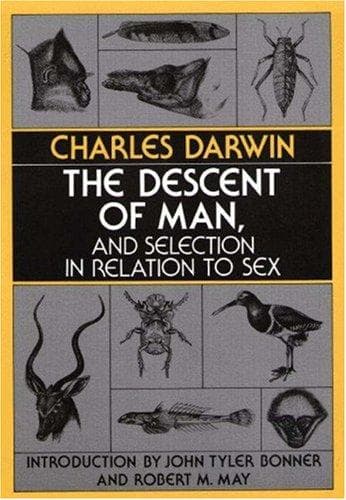
The Descent of Man, and Selection in Relation to SexDarwin, Charles
History
The Descent of Man, and Selection in Relation to Sex
Darwin, Charles
Evolution (Biology); Human beings -- Origin; Sex differences; Sexual dimorphism (Animals); Sexual selection in animals
Our great philosopher, Herbert Spencer, has recently explained his
views on the moral sense. He says (46. Letter to Mr. Mill in Bain’s
‘Mental and Moral Science,’ 1868, p. 722.), “I believe that the
experiences of utility organised and consolidated through all past
generations of the human race, have been producing corresponding
modifications, which, by continued transmission and accumulation, have
become in us certain faculties of moral intuition—certain emotions
responding to right and wrong conduct, which have no apparent basis in
the individual experiences of utility.” There is not the least inherent
improbability, as it seems to me, in virtuous tendencies being more or
less strongly inherited; for, not to mention the various dispositions
and habits transmitted by many of our domestic animals to their
offspring, I have heard of authentic cases in which a desire to steal
and a tendency to lie appeared to run in families of the upper ranks;
and as stealing is a rare crime in the wealthy classes, we can hardly
account by accidental coincidence for the tendency occurring in two or
three members of the same family. If bad tendencies are transmitted, it
is probable that good ones are likewise transmitted. That the state of
the body by affecting the brain, has great influence on the moral
tendencies is known to most of those who have suffered from chronic
derangements of the digestion or liver. The same fact is likewise shewn
by the “perversion or destruction of the moral sense being often one of
the earliest symptoms of mental derangement” (47. Maudsley, ‘Body and
Mind,’ 1870, p. 60.); and insanity is notoriously often inherited.
Except through the principle of the transmission of moral tendencies,
we cannot understand the differences believed to exist in this respect
between the various races of mankind.
Even the partial transmission of virtuous tendencies would be an
immense assistance to the primary impulse derived directly and
indirectly from the social instincts. Admitting for a moment that
virtuous tendencies are inherited, it appears probable, at least in
such cases as chastity, temperance, humanity to animals, etc., that
they become first impressed on the mental organization through habit,
instruction and example, continued during several generations in the
same family, and in a quite subordinate degree, or not at all, by the
individuals possessing such virtues having succeeded best in the
struggle for life. My chief source of doubt with respect to any such
inheritance, is that senseless customs, superstitions, and tastes, such
as the horror of a Hindoo for unclean food, ought on the same principle
to be transmitted. I have not met with any evidence in support of the
transmission of superstitious customs or senseless habits, although in
itself it is perhaps not less probable than that animals should acquire
inherited tastes for certain kinds of food or fear of certain foes.
Public-domain text, read in full here on John Shaqi.
Reviews
Reviews
No reviews yet
Be the first to share your thoughts on this work.
Elsewhere in the archive
Join the Discussion
Join the discussion
Sign in to leave a comment or review.
Sign InorCreate an account