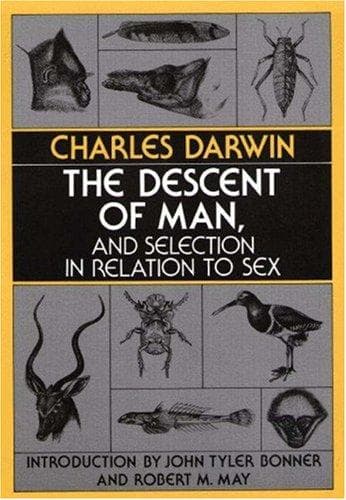
The Descent of Man, and Selection in Relation to SexDarwin, Charles
History
The Descent of Man, and Selection in Relation to Sex
Darwin, Charles
Evolution (Biology); Human beings -- Origin; Sex differences; Sexual dimorphism (Animals); Sexual selection in animals
endeavoured to shew that the social instincts,—the prime principle of
man’s moral constitution (50. ‘The Thoughts of Marcus Aurelius,’ etc.,
p. 139.)—with the aid of active intellectual powers and the effects of
habit, naturally lead to the golden rule, “As ye would that men should
do to you, do ye to them likewise;” and this lies at the foundation of
morality.
In the next chapter I shall make some few remarks on the probable steps
and means by which the several mental and moral faculties of man have
been gradually evolved. That such evolution is at least possible, ought
not to be denied, for we daily see these faculties developing in every
infant; and we may trace a perfect gradation from the mind of an utter
idiot, lower than that of an animal low in the scale, to the mind of a
Newton.
CHAPTER V.
ON THE DEVELOPMENT OF THE INTELLECTUAL AND MORAL FACULTIES DURING
PRIMEVAL AND CIVILISED TIMES.
Advancement of the intellectual powers through natural
selection—Importance of imitation—Social and moral faculties—Their
development within the limits of the same tribe—Natural selection as
affecting civilised nations—Evidence that civilised nations were once
barbarous.
The subjects to be discussed in this chapter are of the highest
interest, but are treated by me in an imperfect and fragmentary manner.
Mr. Wallace, in an admirable paper before referred to (1.
Anthropological Review, May 1864, p. clviii.), argues that man, after
he had partially acquired those intellectual and moral faculties which
distinguish him from the lower animals, would have been but little
liable to bodily modifications through natural selection or any other
means. For man is enabled through his mental faculties “to keep with an
unchanged body in harmony with the changing universe.” He has great
power of adapting his habits to new conditions of life. He invents
weapons, tools, and various stratagems to procure food and to defend
himself. When he migrates into a colder climate he uses clothes, builds
sheds, and makes fires; and by the aid of fire cooks food otherwise
indigestible. He aids his fellow-men in many ways, and anticipates
future events. Even at a remote period he practised some division of
labour.
The lower animals, on the other hand, must have their bodily structure
modified in order to survive under greatly changed conditions. They
must be rendered stronger, or acquire more effective teeth or claws,
for defence against new enemies; or they must be reduced in size, so as
to escape detection and danger. When they migrate into a colder
climate, they must become clothed with thicker fur, or have their
constitutions altered. If they fail to be thus modified, they will
cease to exist.
Public-domain text, read in full here on John Shaqi.
Reviews
Reviews
No reviews yet
Be the first to share your thoughts on this work.
Elsewhere in the archive
Join the Discussion
Join the discussion
Sign in to leave a comment or review.
Sign InorCreate an account