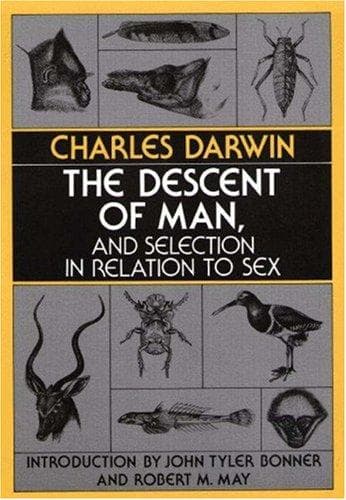
The Descent of Man, and Selection in Relation to SexDarwin, Charles
History
The Descent of Man, and Selection in Relation to Sex
Darwin, Charles
Evolution (Biology); Human beings -- Origin; Sex differences; Sexual dimorphism (Animals); Sexual selection in animals
The case, however, is widely different, as Mr. Wallace has with justice
insisted, in relation to the intellectual and moral faculties of man.
These faculties are variable; and we have every reason to believe that
the variations tend to be inherited. Therefore, if they were formerly
of high importance to primeval man and to his ape-like progenitors,
they would have been perfected or advanced through natural selection.
Of the high importance of the intellectual faculties there can be no
doubt, for man mainly owes to them his predominant position in the
world. We can see, that in the rudest state of society, the individuals
who were the most sagacious, who invented and used the best weapons or
traps, and who were best able to defend themselves, would rear the
greatest number of offspring. The tribes, which included the largest
number of men thus endowed, would increase in number and supplant other
tribes. Numbers depend primarily on the means of subsistence, and this
depends partly on the physical nature of the country, but in a much
higher degree on the arts which are there practised. As a tribe
increases and is victorious, it is often still further increased by the
absorption of other tribes. (2. After a time the members or tribes
which are absorbed into another tribe assume, as Sir Henry Maine
remarks (‘Ancient Law,’ 1861, p. 131), that they are the co-descendants
of the same ancestors.) The stature and strength of the men of a tribe
are likewise of some importance for its success, and these depend in
part on the nature and amount of the food which can be obtained. In
Europe the men of the Bronze period were supplanted by a race more
powerful, and, judging from their sword-handles, with larger hands (3.
Morlot, ‘Soc. Vaud. Sc. Nat.’ 1860, p. 294.); but their success was
probably still more due to their superiority in the arts.
All that we know about savages, or may infer from their traditions and
from old monuments, the history of which is quite forgotten by the
present inhabitants, shew that from the remotest times successful
tribes have supplanted other tribes. Relics of extinct or forgotten
tribes have been discovered throughout the civilised regions of the
earth, on the wild plains of America, and on the isolated islands in
the Pacific Ocean. At the present day civilised nations are everywhere
supplanting barbarous nations, excepting where the climate opposes a
deadly barrier; and they succeed mainly, though not exclusively,
through their arts, which are the products of the intellect. It is,
therefore, highly probable that with mankind the intellectual faculties
have been mainly and gradually perfected through natural selection; and
this conclusion is sufficient for our purpose. Undoubtedly it would be
interesting to trace the development of each separate faculty from the
state in which it exists in the lower animals to that in which it
exists in man; but neither my ability nor knowledge permits the
attempt.
Public-domain text, read in full here on John Shaqi.
Reviews
Reviews
No reviews yet
Be the first to share your thoughts on this work.
Elsewhere in the archive
Join the Discussion
Join the discussion
Sign in to leave a comment or review.
Sign InorCreate an account