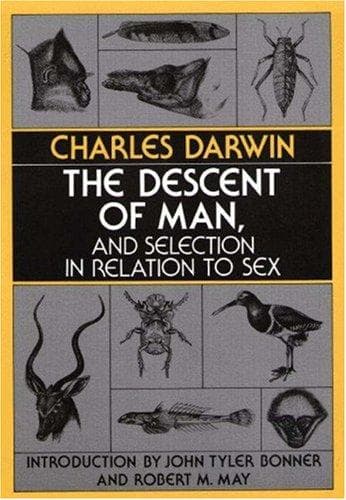
The Descent of Man, and Selection in Relation to SexDarwin, Charles
History
The Descent of Man, and Selection in Relation to Sex
Darwin, Charles
Evolution (Biology); Human beings -- Origin; Sex differences; Sexual dimorphism (Animals); Sexual selection in animals
But it may be asked, how within the limits of the same tribe did a
large number of members first become endowed with these social and
moral qualities, and how was the standard of excellence raised? It is
extremely doubtful whether the offspring of the more sympathetic and
benevolent parents, or of those who were the most faithful to their
comrades, would be reared in greater numbers than the children of
selfish and treacherous parents belonging to the same tribe. He who was
ready to sacrifice his life, as many a savage has been, rather than
betray his comrades, would often leave no offspring to inherit his
noble nature. The bravest men, who were always willing to come to the
front in war, and who freely risked their lives for others, would on an
average perish in larger numbers than other men. Therefore, it hardly
seems probable, that the number of men gifted with such virtues, or
that the standard of their excellence, could be increased through
natural selection, that is, by the survival of the fittest; for we are
not here speaking of one tribe being victorious over another.
Although the circumstances, leading to an increase in the number of
those thus endowed within the same tribe, are too complex to be clearly
followed out, we can trace some of the probable steps. In the first
place, as the reasoning powers and foresight of the members became
improved, each man would soon learn that if he aided his fellow-men, he
would commonly receive aid in return. From this low motive he might
acquire the habit of aiding his fellows; and the habit of performing
benevolent actions certainly strengthens the feeling of sympathy which
gives the first impulse to benevolent actions. Habits, moreover,
followed during many generations probably tend to be inherited.
But another and much more powerful stimulus to the development of the
social virtues, is afforded by the praise and the blame of our
fellow-men. To the instinct of sympathy, as we have already seen, it is
primarily due, that we habitually bestow both praise and blame on
others, whilst we love the former and dread the latter when applied to
ourselves; and this instinct no doubt was originally acquired, like all
the other social instincts, through natural selection. At how early a
period the progenitors of man in the course of their development,
became capable of feeling and being impelled by, the praise or blame of
their fellow-creatures, we cannot of course say. But it appears that
even dogs appreciate encouragement, praise, and blame. The rudest
savages feel the sentiment of glory, as they clearly shew by preserving
the trophies of their prowess, by their habit of excessive boasting,
and even by the extreme care which they take of their personal
appearance and decorations; for unless they regarded the opinion of
their comrades, such habits would be senseless.
Public-domain text, read in full here on John Shaqi.
Reviews
Reviews
No reviews yet
Be the first to share your thoughts on this work.
Elsewhere in the archive
Join the Discussion
Join the discussion
Sign in to leave a comment or review.
Sign InorCreate an account