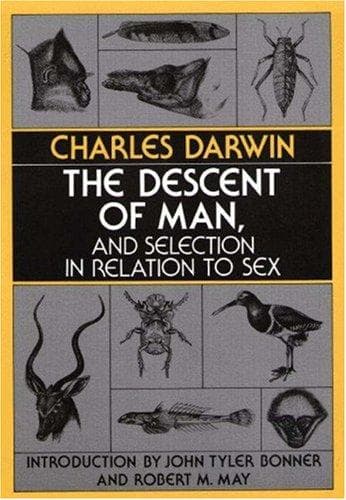
The Descent of Man, and Selection in Relation to SexDarwin, Charles
History
The Descent of Man, and Selection in Relation to Sex
Darwin, Charles
Evolution (Biology); Human beings -- Origin; Sex differences; Sexual dimorphism (Animals); Sexual selection in animals
They certainly feel shame at the breach of some of their lesser rules,
and apparently remorse, as shewn by the case of the Australian who grew
thin and could not rest from having delayed to murder some other woman,
so as to propitiate his dead wife’s spirit. Though I have not met with
any other recorded case, it is scarcely credible that a savage, who
will sacrifice his life rather than betray his tribe, or one who will
deliver himself up as a prisoner rather than break his parole (6. Mr.
Wallace gives cases in his ‘Contributions to the Theory of Natural
Selection,’ 1870, p. 354.), would not feel remorse in his inmost soul,
if he had failed in a duty, which he held sacred.
We may therefore conclude that primeval man, at a very remote period,
was influenced by the praise and blame of his fellows. It is obvious,
that the members of the same tribe would approve of conduct which
appeared to them to be for the general good, and would reprobate that
which appeared evil. To do good unto others—to do unto others as ye
would they should do unto you—is the foundation-stone of morality. It
is, therefore, hardly possible to exaggerate the importance during rude
times of the love of praise and the dread of blame. A man who was not
impelled by any deep, instinctive feeling, to sacrifice his life for
the good of others, yet was roused to such actions by a sense of glory,
would by his example excite the same wish for glory in other men, and
would strengthen by exercise the noble feeling of admiration. He might
thus do far more good to his tribe than by begetting offspring with a
tendency to inherit his own high character.
With increased experience and reason, man perceives the more remote
consequences of his actions, and the self-regarding virtues, such as
temperance, chastity, etc., which during early times are, as we have
before seen, utterly disregarded, come to be highly esteemed or even
held sacred. I need not, however, repeat what I have said on this head
in the fourth chapter. Ultimately our moral sense or conscience becomes
a highly complex sentiment—originating in the social instincts, largely
guided by the approbation of our fellow-men, ruled by reason,
self-interest, and in later times by deep religious feelings, and
confirmed by instruction and habit.
Public-domain text, read in full here on John Shaqi.
Reviews
Reviews
No reviews yet
Be the first to share your thoughts on this work.
Elsewhere in the archive
Join the Discussion
Join the discussion
Sign in to leave a comment or review.
Sign InorCreate an account