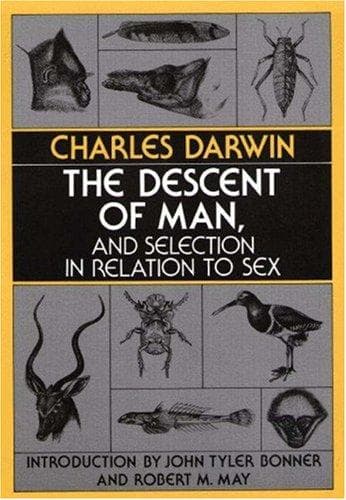
The Descent of Man, and Selection in Relation to SexDarwin, Charles
History
The Descent of Man, and Selection in Relation to Sex
Darwin, Charles
Evolution (Biology); Human beings -- Origin; Sex differences; Sexual dimorphism (Animals); Sexual selection in animals
It must not be forgotten that although a high standard of morality
gives but a slight or no advantage to each individual man and his
children over the other men of the same tribe, yet that an increase in
the number of well-endowed men and an advancement in the standard of
morality will certainly give an immense advantage to one tribe over
another. A tribe including many members who, from possessing in a high
degree the spirit of patriotism, fidelity, obedience, courage, and
sympathy, were always ready to aid one another, and to sacrifice
themselves for the common good, would be victorious over most other
tribes; and this would be natural selection. At all times throughout
the world tribes have supplanted other tribes; and as morality is one
important element in their success, the standard of morality and the
number of well-endowed men will thus everywhere tend to rise and
increase.
It is, however, very difficult to form any judgment why one particular
tribe and not another has been successful and has risen in the scale of
civilisation. Many savages are in the same condition as when first
discovered several centuries ago. As Mr. Bagehot has remarked, we are
apt to look at progress as normal in human society; but history refutes
this. The ancients did not even entertain the idea, nor do the Oriental
nations at the present day. According to another high authority, Sir
Henry Maine (7. ‘Ancient Law,’ 1861, p. 22. For Mr. Bagehot’s remarks,
‘Fortnightly Review,’ April 1, 1868, p. 452.), “the greatest part of
mankind has never shewn a particle of desire that its civil
institutions should be improved.” Progress seems to depend on many
concurrent favourable conditions, far too complex to be followed out.
But it has often been remarked, that a cool climate, from leading to
industry and to the various arts, has been highly favourable thereto.
The Esquimaux, pressed by hard necessity, have succeeded in many
ingenious inventions, but their climate has been too severe for
continued progress. Nomadic habits, whether over wide plains, or
through the dense forests of the tropics, or along the shores of the
sea, have in every case been highly detrimental. Whilst observing the
barbarous inhabitants of Tierra del Fuego, it struck me that the
possession of some property, a fixed abode, and the union of many
families under a chief, were the indispensable requisites for
civilisation. Such habits almost necessitate the cultivation of the
ground; and the first steps in cultivation would probably result, as I
have elsewhere shewn (8. ‘The Variation of Animals and Plants under
Domestication,’ vol. i. p. 309.), from some such accident as the seeds
of a fruit-tree falling on a heap of refuse, and producing an unusually
fine variety. The problem, however, of the first advance of savages
towards civilisation is at present much too difficult to be solved.
NATURAL SELECTION AS AFFECTING CIVILISED NATIONS.
Public-domain text, read in full here on John Shaqi.
Reviews
Reviews
No reviews yet
Be the first to share your thoughts on this work.
Elsewhere in the archive
Join the Discussion
Join the discussion
Sign in to leave a comment or review.
Sign InorCreate an account