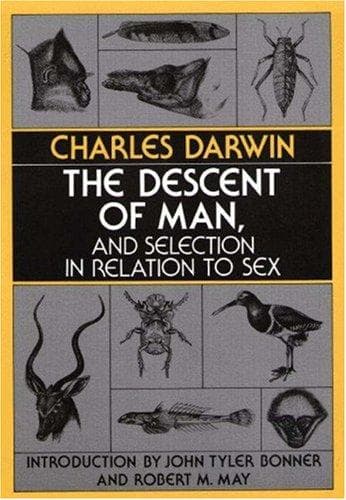
The Descent of Man, and Selection in Relation to SexDarwin, Charles
History
The Descent of Man, and Selection in Relation to Sex
Darwin, Charles
Evolution (Biology); Human beings -- Origin; Sex differences; Sexual dimorphism (Animals); Sexual selection in animals
Man accumulates property and bequeaths it to his children, so that the
children of the rich have an advantage over the poor in the race for
success, independently of bodily or mental superiority. On the other
hand, the children of parents who are short-lived, and are therefore on
an average deficient in health and vigour, come into their property
sooner than other children, and will be likely to marry earlier, and
leave a larger number of offspring to inherit their inferior
constitutions. But the inheritance of property by itself is very far
from an evil; for without the accumulation of capital the arts could
not progress; and it is chiefly through their power that the civilised
races have extended, and are now everywhere extending their range, so
as to take the place of the lower races. Nor does the moderate
accumulation of wealth interfere with the process of selection. When a
poor man becomes moderately rich, his children enter trades or
professions in which there is struggle enough, so that the able in body
and mind succeed best. The presence of a body of well-instructed men,
who have not to labour for their daily bread, is important to a degree
which cannot be over-estimated; as all high intellectual work is
carried on by them, and on such work, material progress of all kinds
mainly depends, not to mention other and higher advantages. No doubt
wealth when very great tends to convert men into useless drones, but
their number is never large; and some degree of elimination here
occurs, for we daily see rich men, who happen to be fools or
profligate, squandering away their wealth.
Primogeniture with entailed estates is a more direct evil, though it
may formerly have been a great advantage by the creation of a dominant
class, and any government is better than none. Most eldest sons, though
they may be weak in body or mind, marry, whilst the younger sons,
however superior in these respects, do not so generally marry. Nor can
worthless eldest sons with entailed estates squander their wealth. But
here, as elsewhere, the relations of civilised life are so complex that
some compensatory checks intervene. The men who are rich through
primogeniture are able to select generation after generation the more
beautiful and charming women; and these must generally be healthy in
body and active in mind. The evil consequences, such as they may be, of
the continued preservation of the same line of descent, without any
selection, are checked by men of rank always wishing to increase their
wealth and power; and this they effect by marrying heiresses. But the
daughters of parents who have produced single children, are themselves,
as Mr. Galton (12. ‘Hereditary Genius,’ 1870, pp. 132-140.) has shewn,
apt to be sterile; and thus noble families are continually cut off in
the direct line, and their wealth flows into some side channel; but
unfortunately this channel is not determined by superiority of any
kind.
Public-domain text, read in full here on John Shaqi.
Reviews
Reviews
No reviews yet
Be the first to share your thoughts on this work.
Elsewhere in the archive
Join the Discussion
Join the discussion
Sign in to leave a comment or review.
Sign InorCreate an account