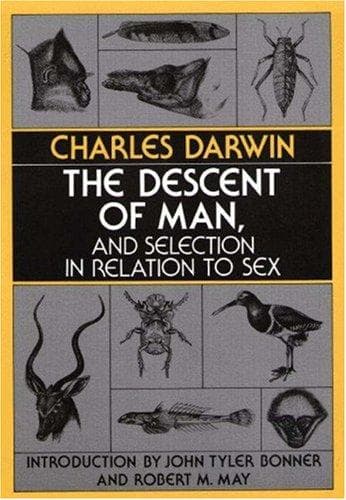
The Descent of Man, and Selection in Relation to SexDarwin, Charles
History
The Descent of Man, and Selection in Relation to Sex
Darwin, Charles
Evolution (Biology); Human beings -- Origin; Sex differences; Sexual dimorphism (Animals); Sexual selection in animals
Although civilisation thus checks in many ways the action of natural
selection, it apparently favours the better development of the body, by
means of good food and the freedom from occasional hardships. This may
be inferred from civilised men having been found, wherever compared, to
be physically stronger than savages. (13. Quatrefages, ‘Revue des Cours
Scientifiques,’ 1867-68, p. 659.) They appear also to have equal powers
of endurance, as has been proved in many adventurous expeditions. Even
the great luxury of the rich can be but little detrimental; for the
expectation of life of our aristocracy, at all ages and of both sexes,
is very little inferior to that of healthy English lives in the lower
classes. (14. See the fifth and sixth columns, compiled from good
authorities, in the table given in Mr. E.R. Lankester’s ‘Comparative
Longevity,’ 1870, p. 115.)
We will now look to the intellectual faculties. If in each grade of
society the members were divided into two equal bodies, the one
including the intellectually superior and the other the inferior, there
can be little doubt that the former would succeed best in all
occupations, and rear a greater number of children. Even in the lowest
walks of life, skill and ability must be of some advantage; though in
many occupations, owing to the great division of labour, a very small
one. Hence in civilised nations there will be some tendency to an
increase both in the number and in the standard of the intellectually
able. But I do not wish to assert that this tendency may not be more
than counterbalanced in other ways, as by the multiplication of the
reckless and improvident; but even to such as these, ability must be
some advantage.
Public-domain text, read in full here on John Shaqi.
Reviews
Reviews
No reviews yet
Be the first to share your thoughts on this work.
Elsewhere in the archive
Join the Discussion
Join the discussion
Sign in to leave a comment or review.
Sign InorCreate an account