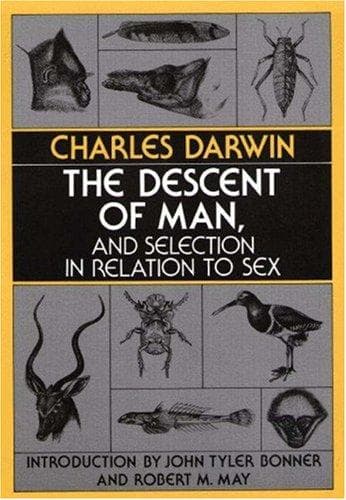
The Descent of Man, and Selection in Relation to SexDarwin, Charles
History
The Descent of Man, and Selection in Relation to Sex
Darwin, Charles
Evolution (Biology); Human beings -- Origin; Sex differences; Sexual dimorphism (Animals); Sexual selection in animals
make their appearance in families, may perhaps be reversions to a
savage state, from which we are not removed by very many generations.
This view seems indeed recognised in the common expression that such
men are the black sheep of the family.
With civilised nations, as far as an advanced standard of morality, and
an increased number of fairly good men are concerned, natural selection
apparently effects but little; though the fundamental social instincts
were originally thus gained. But I have already said enough, whilst
treating of the lower races, on the causes which lead to the advance of
morality, namely, the approbation of our fellow-men—the strengthening
of our sympathies by habit—example and imitation—reason—experience, and
even self-interest—instruction during youth, and religious feelings.
A most important obstacle in civilised countries to an increase in the
number of men of a superior class has been strongly insisted on by Mr.
Greg and Mr. Galton (19. ‘Fraser’s Magazine,’ Sept. 1868, p. 353.
‘Macmillan’s Magazine,’ Aug. 1865, p. 318. The Rev. F.W. Farrar
(‘Fraser’s Magazine,’ Aug. 1870, p. 264) takes a different view.),
namely, the fact that the very poor and reckless, who are often
degraded by vice, almost invariably marry early, whilst the careful and
frugal, who are generally otherwise virtuous, marry late in life, so
that they may be able to support themselves and their children in
comfort. Those who marry early produce within a given period not only a
greater number of generations, but, as shewn by Dr. Duncan (20. ‘On the
Laws of the Fertility of Women,’ in ‘Transactions of the Royal
Society,’ Edinburgh, vol. xxiv. p. 287; now published separately under
the title of ‘Fecundity, Fertility, and Sterility,’ 1871. See, also,
Mr. Galton, ‘Hereditary Genius,’ pp. 352-357, for observations to the
above effect.), they produce many more children. The children,
moreover, that are borne by mothers during the prime of life are
heavier and larger, and therefore probably more vigorous, than those
born at other periods. Thus the reckless, degraded, and often vicious
members of society, tend to increase at a quicker rate than the
provident and generally virtuous members. Or as Mr. Greg puts the case:
“The careless, squalid, unaspiring Irishman multiplies like rabbits:
the frugal, foreseeing, self-respecting, ambitious Scot, stern in his
morality, spiritual in his faith, sagacious and disciplined in his
intelligence, passes his best years in struggle and in celibacy,
marries late, and leaves few behind him. Given a land originally
peopled by a thousand Saxons and a thousand Celts—and in a dozen
generations five-sixths of the population would be Celts, but
five-sixths of the property, of the power, of the intellect, would
belong to the one-sixth of Saxons that remained. In the eternal
‘struggle for existence,’ it would be the inferior and LESS favoured
race that had prevailed—and prevailed by virtue not of its good
qualities but of its faults.”
Public-domain text, read in full here on John Shaqi.
Reviews
Reviews
No reviews yet
Be the first to share your thoughts on this work.
Elsewhere in the archive
Join the Discussion
Join the discussion
Sign in to leave a comment or review.
Sign InorCreate an account