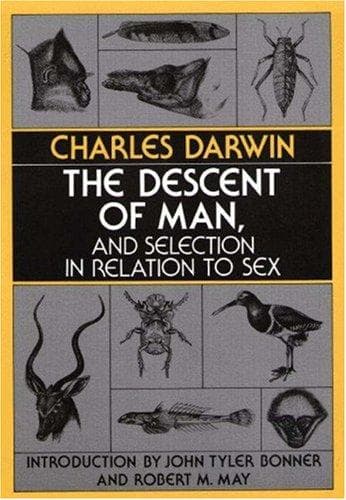
The Descent of Man, and Selection in Relation to SexDarwin, Charles
History
The Descent of Man, and Selection in Relation to Sex
Darwin, Charles
Evolution (Biology); Human beings -- Origin; Sex differences; Sexual dimorphism (Animals); Sexual selection in animals
It has often been objected to views like the foregoing, that the most
eminent men who have ever lived have left no offspring to inherit their
great intellect. Mr. Galton says, “I regret I am unable to solve the
simple question whether, and how far, men and women who are prodigies
of genius are infertile. I have, however, shewn that men of eminence
are by no means so.” (15. ‘Hereditary Genius,’ 1870, p. 330.) Great
lawgivers, the founders of beneficent religions, great philosophers and
discoverers in science, aid the progress of mankind in a far higher
degree by their works than by leaving a numerous progeny. In the case
of corporeal structures, it is the selection of the slightly
better-endowed and the elimination of the slightly less well-endowed
individuals, and not the preservation of strongly-marked and rare
anomalies, that leads to the advancement of a species. (16. ‘Origin of
Species’ (fifth edition, 1869), p. 104.) So it will be with the
intellectual faculties, since the somewhat abler men in each grade of
society succeed rather better than the less able, and consequently
increase in number, if not otherwise prevented. When in any nation the
standard of intellect and the number of intellectual men have
increased, we may expect from the law of the deviation from an average,
that prodigies of genius will, as shewn by Mr. Galton, appear somewhat
more frequently than before.
In regard to the moral qualities, some elimination of the worst
dispositions is always in progress even in the most civilised nations.
Malefactors are executed, or imprisoned for long periods, so that they
cannot freely transmit their bad qualities. Melancholic and insane
persons are confined, or commit suicide. Violent and quarrelsome men
often come to a bloody end. The restless who will not follow any steady
occupation—and this relic of barbarism is a great check to civilisation
(17. ‘Hereditary Genius,’ 1870, p. 347.)—emigrate to newly-settled
countries; where they prove useful pioneers. Intemperance is so highly
destructive, that the expectation of life of the intemperate, at the
age of thirty for instance, is only 13.8 years; whilst for the rural
labourers of England at the same age it is 40.59 years. (18. E. Ray
Lankester, ‘Comparative Longevity,’ 1870, p. 115. The table of the
intemperate is from Neison’s ‘Vital Statistics.’ In regard to
profligacy, see Dr. Farr, ‘Influence of Marriage on Mortality,’ ‘Nat.
Assoc. for the Promotion of Social Science,’ 1858.) Profligate women
bear few children, and profligate men rarely marry; both suffer from
disease. In the breeding of domestic animals, the elimination of those
individuals, though few in number, which are in any marked manner
inferior, is by no means an unimportant element towards success. This
especially holds good with injurious characters which tend to reappear
through reversion, such as blackness in sheep; and with mankind some of
the worst dispositions, which occasionally without any assignable cause
Public-domain text, read in full here on John Shaqi.
Reviews
Reviews
No reviews yet
Be the first to share your thoughts on this work.
Elsewhere in the archive
Join the Discussion
Join the discussion
Sign in to leave a comment or review.
Sign InorCreate an account