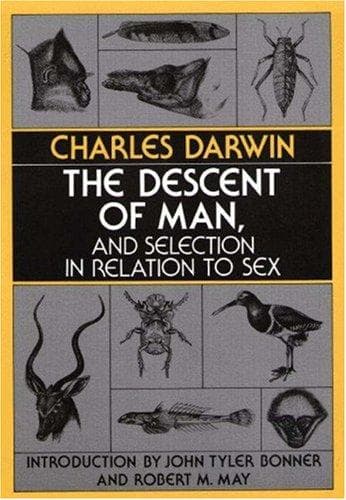
The Descent of Man, and Selection in Relation to SexDarwin, Charles
History
The Descent of Man, and Selection in Relation to Sex
Darwin, Charles
Evolution (Biology); Human beings -- Origin; Sex differences; Sexual dimorphism (Animals); Sexual selection in animals
It was established from an enormous body of statistics, taken during
1853, that the unmarried men throughout France, between the ages of
twenty and eighty, die in a much larger proportion than the married:
for instance, out of every 1000 unmarried men, between the ages of
twenty and thirty, 11.3 annually died, whilst of the married, only 6.5
died. (23. Dr. Farr, ibid. The quotations given below are extracted
from the same striking paper.) A similar law was proved to hold good,
during the years 1863 and 1864, with the entire population above the
age of twenty in Scotland: for instance, out of every 1000 unmarried
men, between the ages of twenty and thirty, 14.97 annually died, whilst
of the married only 7.24 died, that is less than half. (24. I have
taken the mean of the quinquennial means, given in ‘The Tenth Annual
Report of Births, Deaths, etc., in Scotland,’ 1867. The quotation from
Dr. Stark is copied from an article in the ‘Daily News,’ Oct. 17, 1868,
which Dr. Farr considers very carefully written.) Dr. Stark remarks on
this, “Bachelorhood is more destructive to life than the most
unwholesome trades, or than residence in an unwholesome house or
district where there has never been the most distant attempt at
sanitary improvement.” He considers that the lessened mortality is the
direct result of “marriage, and the more regular domestic habits which
attend that state.” He admits, however, that the intemperate,
profligate, and criminal classes, whose duration of life is low, do not
commonly marry; and it must likewise be admitted that men with a weak
constitution, ill health, or any great infirmity in body or mind, will
often not wish to marry, or will be rejected. Dr. Stark seems to have
come to the conclusion that marriage in itself is a main cause of
prolonged life, from finding that aged married men still have a
considerable advantage in this respect over the unmarried of the same
advanced age; but every one must have known instances of men, who with
weak health during youth did not marry, and yet have survived to old
age, though remaining weak, and therefore always with a lessened chance
of life or of marrying. There is another remarkable circumstance which
seems to support Dr. Stark’s conclusion, namely, that widows and
widowers in France suffer in comparison with the married a very heavy
rate of mortality; but Dr. Farr attributes this to the poverty and evil
habits consequent on the disruption of the family, and to grief. On the
whole we may conclude with Dr. Farr that the lesser mortality of
married than of unmarried men, which seems to be a general law, “is
mainly due to the constant elimination of imperfect types, and to the
skilful selection of the finest individuals out of each successive
generation;” the selection relating only to the marriage state, and
acting on all corporeal, intellectual, and moral qualities. (25. Dr.
Duncan remarks (‘Fecundity, Fertility, etc.’ 1871, p. 334) on this
Public-domain text, read in full here on John Shaqi.
Reviews
Reviews
No reviews yet
Be the first to share your thoughts on this work.
Elsewhere in the archive
Join the Discussion
Join the discussion
Sign in to leave a comment or review.
Sign InorCreate an account