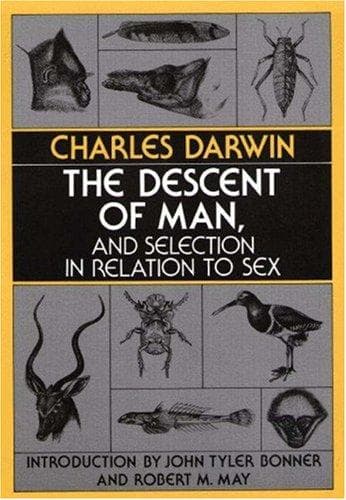
The Descent of Man, and Selection in Relation to SexDarwin, Charles
History
The Descent of Man, and Selection in Relation to Sex
Darwin, Charles
Evolution (Biology); Human beings -- Origin; Sex differences; Sexual dimorphism (Animals); Sexual selection in animals
subject: “At every age the healthy and beautiful go over from the
unmarried side to the married, leaving the unmarried columns crowded
with the sickly and unfortunate.”) We may, therefore, infer that sound
and good men who out of prudence remain for a time unmarried, do not
suffer a high rate of mortality.
If the various checks specified in the two last paragraphs, and perhaps
others as yet unknown, do not prevent the reckless, the vicious and
otherwise inferior members of society from increasing at a quicker rate
than the better class of men, the nation will retrograde, as has too
often occurred in the history of the world. We must remember that
progress is no invariable rule. It is very difficult to say why one
civilised nation rises, becomes more powerful, and spreads more widely,
than another; or why the same nation progresses more quickly at one
time than at another. We can only say that it depends on an increase in
the actual number of the population, on the number of men endowed with
high intellectual and moral faculties, as well as on their standard of
excellence. Corporeal structure appears to have little influence,
except so far as vigour of body leads to vigour of mind.
It has been urged by several writers that as high intellectual powers
are advantageous to a nation, the old Greeks, who stood some grades
higher in intellect than any race that has ever existed (26. See the
ingenious and original argument on this subject by Mr. Galton,
‘Hereditary Genius,’ pp. 340-342.), ought, if the power of natural
selection were real, to have risen still higher in the scale, increased
in number, and stocked the whole of Europe. Here we have the tacit
assumption, so often made with respect to corporeal structures, that
there is some innate tendency towards continued development in mind and
body. But development of all kinds depends on many concurrent
favourable circumstances. Natural selection acts only tentatively.
Individuals and races may have acquired certain indisputable
advantages, and yet have perished from failing in other characters. The
Greeks may have retrograded from a want of coherence between the many
small states, from the small size of their whole country, from the
practice of slavery, or from extreme sensuality; for they did not
succumb until “they were enervated and corrupt to the very core.” (27.
Mr. Greg, ‘Fraser’s Magazine,’ Sept. 1868, p. 357.) The western nations
of Europe, who now so immeasurably surpass their former savage
progenitors, and stand at the summit of civilisation, owe little or
none of their superiority to direct inheritance from the old Greeks,
though they owe much to the written works of that wonderful people.
Public-domain text, read in full here on John Shaqi.
Reviews
Reviews
No reviews yet
Be the first to share your thoughts on this work.
Elsewhere in the archive
Join the Discussion
Join the discussion
Sign in to leave a comment or review.
Sign InorCreate an account