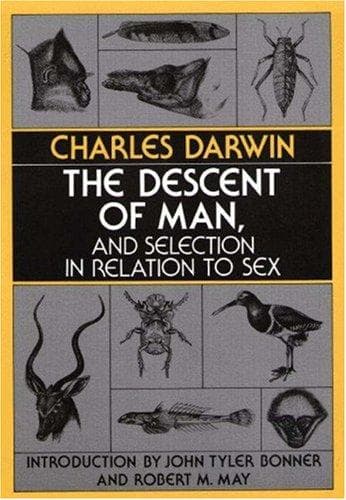
The Descent of Man, and Selection in Relation to SexDarwin, Charles
History
The Descent of Man, and Selection in Relation to Sex
Darwin, Charles
Evolution (Biology); Human beings -- Origin; Sex differences; Sexual dimorphism (Animals); Sexual selection in animals
Natural selection follows from the struggle for existence; and this
from a rapid rate of increase. It is impossible not to regret bitterly,
but whether wisely is another question, the rate at which man tends to
increase; for this leads in barbarous tribes to infanticide and many
other evils, and in civilised nations to abject poverty, celibacy, and
to the late marriages of the prudent. But as man suffers from the same
physical evils as the lower animals, he has no right to expect an
immunity from the evils consequent on the struggle for existence. Had
he not been subjected during primeval times to natural selection,
assuredly he would never have attained to his present rank. Since we
see in many parts of the world enormous areas of the most fertile land
capable of supporting numerous happy homes, but peopled only by a few
wandering savages, it might be argued that the struggle for existence
had not been sufficiently severe to force man upwards to his highest
standard. Judging from all that we know of man and the lower animals,
there has always been sufficient variability in their intellectual and
moral faculties, for a steady advance through natural selection. No
doubt such advance demands many favourable concurrent circumstances;
but it may well be doubted whether the most favourable would have
sufficed, had not the rate of increase been rapid, and the consequent
struggle for existence extremely severe. It even appears from what we
see, for instance, in parts of S. America, that a people which may be
called civilised, such as the Spanish settlers, is liable to become
indolent and to retrograde, when the conditions of life are very easy.
With highly civilised nations continued progress depends in a
subordinate degree on natural selection; for such nations do not
supplant and exterminate one another as do savage tribes. Nevertheless
the more intelligent members within the same community will succeed
better in the long run than the inferior, and leave a more numerous
progeny, and this is a form of natural selection. The more efficient
causes of progress seem to consist of a good education during youth
whilst the brain is impressible, and of a high standard of excellence,
inculcated by the ablest and best men, embodied in the laws, customs
and traditions of the nation, and enforced by public opinion. It
should, however, be borne in mind, that the enforcement of public
opinion depends on our appreciation of the approbation and
disapprobation of others; and this appreciation is founded on our
sympathy, which it can hardly be doubted was originally developed
through natural selection as one of the most important elements of the
social instincts. (31. I am much indebted to Mr. John Morley for some
good criticisms on this subject: see, also Broca, ‘Les Selections,’
‘Revue d’Anthropologie,’ 1872.)
ON THE EVIDENCE THAT ALL CIVILISED NATIONS WERE ONCE BARBAROUS.
Public-domain text, read in full here on John Shaqi.
Reviews
Reviews
No reviews yet
Be the first to share your thoughts on this work.
Elsewhere in the archive
Join the Discussion
Join the discussion
Sign in to leave a comment or review.
Sign InorCreate an account