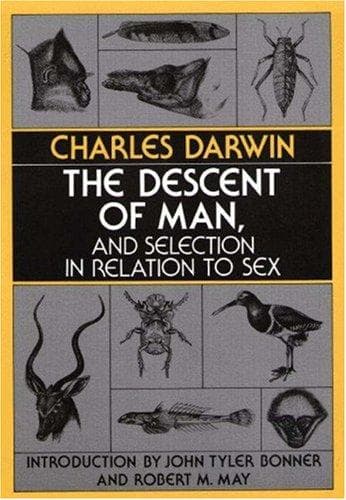
The Descent of Man, and Selection in Relation to SexDarwin, Charles
History
The Descent of Man, and Selection in Relation to Sex
Darwin, Charles
Evolution (Biology); Human beings -- Origin; Sex differences; Sexual dimorphism (Animals); Sexual selection in animals
Who can positively say why the Spanish nation, so dominant at one time,
has been distanced in the race. The awakening of the nations of Europe
from the dark ages is a still more perplexing problem. At that early
period, as Mr. Galton has remarked, almost all the men of a gentle
nature, those given to meditation or culture of the mind, had no refuge
except in the bosom of a Church which demanded celibacy (28.
‘Hereditary Genius,’ 1870, pp. 357-359. The Rev. F.W. Farrar (‘Fraser’s
Magazine,’ Aug. 1870, p. 257) advances arguments on the other side. Sir
C. Lyell had already (‘Principles of Geology,’ vol. ii. 1868, p. 489),
in a striking passage called attention to the evil influence of the
Holy Inquisition in having, through selection, lowered the general
standard of intelligence in Europe.); and this could hardly fail to
have had a deteriorating influence on each successive generation.
During this same period the Holy Inquisition selected with extreme care
the freest and boldest men in order to burn or imprison them. In Spain
alone some of the best men—those who doubted and questioned, and
without doubting there can be no progress—were eliminated during three
centuries at the rate of a thousand a year. The evil which the Catholic
Church has thus effected is incalculable, though no doubt
counterbalanced to a certain, perhaps to a large, extent in other ways;
nevertheless, Europe has progressed at an unparalleled rate.
The remarkable success of the English as colonists, compared to other
European nations, has been ascribed to their “daring and persistent
energy”; a result which is well illustrated by comparing the progress
of the Canadians of English and French extraction; but who can say how
the English gained their energy? There is apparently much truth in the
belief that the wonderful progress of the United States, as well as the
character of the people, are the results of natural selection; for the
more energetic, restless, and courageous men from all parts of Europe
have emigrated during the last ten or twelve generations to that great
country, and have there succeeded best. (29. Mr. Galton, ‘Macmillan’s
Magazine,’ August 1865, p. 325. See also, ‘Nature,’ ‘On Darwinism and
National Life,’ Dec. 1869, p. 184.) Looking to the distant future, I do
not think that the Rev. Mr. Zincke takes an exaggerated view when he
says (30. ‘Last Winter in the United States,’ 1868, p. 29.): “All other
series of events—as that which resulted in the culture of mind in
Greece, and that which resulted in the empire of Rome—only appear to
have purpose and value when viewed in connection with, or rather as
subsidiary to...the great stream of Anglo-Saxon emigration to the
west.” Obscure as is the problem of the advance of civilisation, we can
at least see that a nation which produced during a lengthened period
the greatest number of highly intellectual, energetic, brave,
patriotic, and benevolent men, would generally prevail over less
favoured nations.
Public-domain text, read in full here on John Shaqi.
Reviews
Reviews
No reviews yet
Be the first to share your thoughts on this work.
Elsewhere in the archive
Join the Discussion
Join the discussion
Sign in to leave a comment or review.
Sign InorCreate an account